(This story includes a death by suicide.)

“FRANK Forester,” as he was already widely known, came to Newark trailing tragedy and grief. Death had claimed his young wife the year before; their infant daughter, too. He agreed to a further bereavement, sending off his four-year-old son to be raised in the home of the lad’s English grandparents. As it turned out, the boy would never see his father again.
Born Henry William Herbert in London in 1807, this unfortunate gentleman was the grandson of an earl, son of the Dean of Manchester, and a promising student of languages at Eton College. Young Herbert had a life of wealth and comfort before him, perhaps even a hereditary title. But having given over his university years largely to field sports and horsemanship, then brought low by “early indiscretions and College debts,” he set out, like many young Englishmen of his class, for America. In so doing, he banished himself unwittingly from his native land forever.1
Herbert found work teaching in a New York classical school, and began to supplement his income with freelance writing and translating. Of all his many and varied works, those about the sporting life, often illustrated with his own drawings and woodcuts, proved the most successful effusions of his pen. The pastimes of fishing, hunting and horses had acquired a “prestige of brutality and rudeness,” a reputation Herbert aspired to correct. But, lest his other works be tainted by those associations, he adopted the pseudonym “Frank Forester” for his pioneer writings on outdoor sports.2
Following his wife’s death, Herbert used money from his father to buy an isolated, wooded tract midway between Newark and Belleville. There he had a rustic cabin built that he called “The Cedars.” It was from this spot, nestled between the new “rural” cemetery at Mount Pleasant and “a beautiful reach of the smooth, silvery Passaic,” that “Frank Forester” became the first in America to fashion a career writing about the sports he loved.3
While indifferent to most worldly preoccupations, Herbert couldn’t sever all ties, either from New York publishers or his Newark neighbors. In fact, on regular visits to the nearer city he became a familiar sight, if oddly attired and “always with a troop of dogs at his heels.”4 He can even be said to have made friends there.
In 1846, writing as Frank Forester, he sold a series of “letters and sketches” to William B. Kinney of the Newark Daily Advertiser. All but one of these were light-hearted depictions of “country life,” the first ending in an open invitation: “Now you know how I live, if you desire to see where, come and pay me a visit at the Cedars.” The sixth and last sketch highlighted Herbert’s devotion to wildlife conservation, heralding a ban on summer hunting for which he had tirelessly advocated.5
Over the years both William Kinney and his son, who in 1851 took over the Advertiser, did their part to promote the books of Forester (“Henry Wm. Herbert, Esq. of this city”), and announced their appearance in sometimes celebratory terms.6 Herbert was paid handsomely to write the 1855 Annual Address, a verse composition that carriers of the newspaper delivered to their patrons on New Year’s Day.7 Later the same year, he was commissioned to write an ode for the dedication of Fairmount Cemetery, on Newark’s west side.8
It’s difficult not to regard Henry William Herbert–impetuous, intemperate, sometimes morose–as the very antithesis of the prudent, proper, affable William A. Whitehead, to whom these essays are dedicated. Yet, as a contemporary of Herbert, a Newark resident, a friend of the Kinneys and a fellow contributor to the Daily Advertiser, Whitehead was surely aware of the other man, even if evidence is wanting of direct dealings between them. Indeed on at least one occasion, it seems, the actions of Herbert cast a pall over Whitehead’s normally cheerful disposition.
One day, authorities were alarmed to discover evidence of a grave act of vandalism, committed inside a quiet building on Market Street. Entries on “Angling,” “Horse” and “Hound” had been sliced from the Newark library’s copy of the Encyclopædia Britannica: a theft of more than 50 densely printed, two-column pages by some of the foremost experts in their fields.9

Its co-founder, and in his seventh year as its president, Whitehead took seriously and personally this “most wanton assault” on the Newark Library Association. Most injuries to its books, he said, could be ascribed to the carelessness of youth, but the articles pilfered in this case were “not likely to engross particularly” the boys of Newark. The deed must have been premeditated, and “the perpetrator of the outrage” a responsible adult. The offer of a monetary reward failed to locate the culprit, but that Herbert had committed the crime was as good as certain.10
While in this instance he may have eluded detection, Henry Herbert couldn’t conceal his upper-class conditioning, or ignore the harsh disparities of American life. To go hunting in the South where one found “the gentlemen of the land, not pent up in cities, but dwelling on their estates,” was in his view “the sport, par excellence.”11 Yet he had little patience for high-born niceties, and still less for hypocrisy. When a New Jersey Railroad train on which he was a passenger ran over an aged Black woman, he could prevail on none of the “well bred, well dressed Newark gentlemen” gathered around her “to aid me in lifting that dying woman out of the ditch.” Had it not been for a damning letter from Herbert to the editor of the Advertiser, neither the incident, nor the negligence that caused it, nor “the most bestial inhumanity” of the bystanders would have been remarked upon. “Had she been White, Young, and Rich,” he wrote, “her death and the accident might possibly have reached your ears.”12
Despite considerable authorial talent and success, Herbert was tormented by loneliness, financial insecurity and depression. The rector of Newark’s House of Prayer, who officiated at his fateful second marriage in February 1858, would three months later deny him Christian burial, or even a prayer at the grave, after Herbert ended his life by a pistol shot to the breast.13
In a set of heartbreaking letters addressed to the coroner, to the press and to friends, which the papers printed in full, Herbert spelled out the causes of his suicide and left plans for its aftermath. He blamed–and forgave–“those women and men of Newark” who had first turned his new bride against him. “My own unhappy temper,” he allowed, “did the rest.” From the press he asked neither eulogy nor vilification–only silence. His burial should be attended with “no funeral, no pomp,” and just a “very small, very plain” local stone should indicate the grave of this “most miserable man,” bearing the words
HENRY WILLIAM HERBERT,
of
England,
aged 51 years.
Infelicissimus.14
Many years would pass before this final wish could be fulfilled.
During the second winter after Herbert’s demise, William Whitehead was to stand at the place of his interment, then recount this visit in a column for a New York daily. The story was reprinted two days later in the Newark Advertiser.15
Mount Pleasant Cemetery’s handsome grounds, Whitehead wrote, offered “even at this dreary season many attractions to the eye of the visitor,” although such scenes could never replace in his affections a crowded and crumbling ancient churchyard. By their spaciousness and separation, the new-fangled, artfully landscaped cities of the dead too often became arenas of ostentation and amusement for the living. Whitehead observed that casual visitors to a rural cemetery were less wont to ponder their own mortality, and more apt to admire or criticize “the various exhibitions of good and bad taste,–of exquisite refinement and vulgar tawdriness,” that crowded the gracefully winding paths and carriage roads.
Threading his way along Mount Pleasant’s serpentine avenues, Whitehead spotted amidst the costly monuments and plantings a grave, by which he was deeply affected. All alone, in the middle of a large family plot, was a small, unmarked mound, the last resting place, not of Herbert, but of an unnamed infant. “There slept the first of the family that reaper, Death, had gathered,” he reflected, “the pioneer of all the others to the unseen world. The grave occupied the centre of the enclosure, for oh! how the love and thoughts of all had converged upon its little occupant!” For a man who had escorted more than a few young children to their graves, including two of his own, this sight recalled the poignant faith of Dickens’s schoolmaster Mr. Marton: “There is not an angel added to the host of Heaven but does its blessed work on earth in those who loved it here.”16
Inquiring after Herbert’s resting place, Whitehead was pointed to another plot. This burial, too, was unmarked, an omission it would take eighteen years and the formation of a Newark Herbert Association to rectify. On this day Whitehead found no monument or epitaph; the spot that Herbert occupied had nothing to attract the attention or interest of a passerby.17
While he wished not to intrude on the silence that Herbert had asked for, Whitehead couldn’t help but remark on the contrasting sentiments with which he viewed these two lonely graves. The second, containing “all that was mortal of one who died by his own hand,” called for a recognition that “such a life and such a death” had their own lesson to teach: “that education, accomplishments, literary fame, honorable birth and proud connections, are valueless without higher principles….”
If he felt any sympathy for Herbert and his sufferings, Whitehead didn’t disclose it here. Rather, he remarked how the “indulgence of appetites and passions” could turn one’s existence into “a curse ‘too heavy to be borne’….” Indulgence of appetites and passions, he implied, had led to Herbert’s self-destruction. “Yes! the dead speak–old and young–in notes of peace and encouragement, or of anguish and warning.”
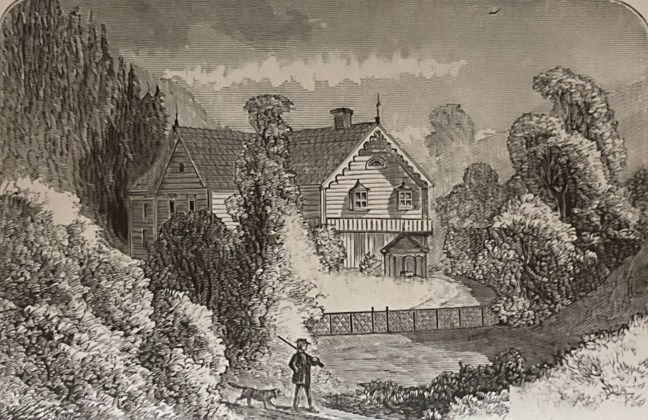
Whitehead went on to the far edge of Mount Pleasant to look upon Henry Herbert’s late home, The Cedars. Towering trees all but concealed the vacant house from view. Creeping plants and climbing vines enhanced its rustic charms. Yet, already, Herbert’s retreat was being overtaken by weeds; the care of the grounds was sadly neglected, and an air of desolation hung about the place, reminding him further of its former owner’s wretched end.18 Whitehead’s reflections might well be tempered by one other: what a tender, fragile thing is life. All of life.
Copyright © 2023-2026 Gregory J. Guderian
[1] Autobiographical note of Henry William Herbert, Duyckinck Family Papers, Manuscripts and Archives Division, New York Public Library, MssCol 873, Box 8/22. This sketch accompanied a letter from Herbert to Evert Augustus Duyckinck, dated 10 April 1852.
[2] Frank Forester, The Cedars, 1 June 1849, to William Trotter Porter, published in “The late George Porter, Esq.,” Spirit of the times. A chronicle of the turf, agriculture, field sports, literature and the stage 19:16 (9 June 1849) 186:2.
[3] Frank Forester, “Among the mountains; or taking times along a trout-stream,” Graham’s magazine 44:2-3 (February-March 1854) (144-147, 298-306) 144.
[4] C. G. Hine, Woodside. The north end of Newark, N. J. Its history, legends and ghost stories gathered from the records and the older inhabitants now living ([New York] 1909, hereafter “Hine, Woodside”) 16.
[5] Newark (N.J.) daily advertiser 4 May 1846 2:2. The articles appeared as follows: “Country life–Letter I,” 4 May 1846 2:3; “About a sail boat–Letter II,” 7 May 1846 2:3; “Letter III,” 12 May 1846 2:4; “Letter IV.–About black ducks,” 15 May 1846 2:4; “Letter V.–About bantams,” 19 May 1846 2:4; “Letter VI.–About the game laws,” 23 May 1846 2:4. Summertime hunting, the author argued, had brought the woodcock to the verge of extinction: see Frank Forester, “The game of North America; its nomenclature, habits, haunts, and seasons; with hints on the science of woodcraft,” The United States magazine, and democratic review n.s. 17:90 (December 1846) 461-466; 18:91-94 (January–April 1846) 17-23, 130-135, 187-192, 282-288.
[6] See, for example, Newark daily advertiser 23 April 1846 2:1; “Literary notices,” Newark daily advertiser 2 October 1849 2:2; “Recent publications,” Newark daily advertiser 1 June 1851 2:2.
[7] See Frank Pierce Hill and Varnum Lansing Collins, comp. Books pamphlets and newspapers printed at Newark New Jersey 1776-1900 (1902) 72, 75. Herbert was said to have called this “the best paid piece of work he ever wrote….” Mrs. E. B. Hornby, Under old rooftrees (Jersey City, N.J. 1908) 229; cf. William Southworth Hunt, Frank Forester [Henry William Herbert]. A tragedy in exile (Newark 1933) 111.
[8] Organization and dedicatory services of the Fairmount Cemetery (Newark 1855) 13-15, reprinted in Organization, dedicatory services and by-laws of the Fairmount Cemetery, of Newark, N. J. (Newark 1887) 17-19; cf. Newark daily advertiser 5 September 1855 2:4. George B. Halsted, speaking at the dedication of Herbert’s gravestone in 1876, recalled an ode that he had composed for the Mount Pleasant Cemetery dedication, fully eleven years before the one written for Fairmount. I’ve found no trace of the earlier poem, and as no ode is mentioned in a contemporary report of the dedication I suspect Halsted misremembered the occasion. The Newark Herbert Association to “Frank Forester.” In memoriam, May 19, 1876 (Newark 1876; hereafter “The Newark Herbert Association”) 15. See Newark daily advertiser 19 June 1844 2:5.
[9] The 7th edition, with a publishing date of 1842, was then Britannica’s current one. “Angling,” in the third of its 21 volumes, was by James Wilson (1795-1856), while “Horse,” “Horsemanship” and “Hound” in volume 11 were the work of Charles Apperley (1778-1843). The second article stolen was named originally as “Horsemanship,” but later as “Horse.” See the next note.
[10] “$10 reward,” Newark daily advertiser 25 September 1857 3:1; “Newark Library Association,” Newark daily advertiser 7 January 1858 2:3. Acquaintances remembered Herbert as then working on his two-volume Field Sports of the United States (see next note), of which at least six American editions had already been issued. If the recollection was accurate, he must have been making revisions, perhaps for the seventh or eighth edition. Arminius Alba, “The Cedars,” Newark daily advertiser 13 March 1880 1:1-2, quoted in Hine, Woodside 15-16. See William Mitchell Van Winkle, comp. Henry William Herbert [Frank Forester]. A bibliography of his writings 1832-1858 (Portland, Me. 1936) 25-28.
[11] Henry William Herbert, Frank Forester’s field sports of the United States, and British provinces, of North America (2 vols. New York 18491) 2:246-247.
[12] Beneath Herbert’s letter, dated 6 September 1847 and printed in Newark daily advertiser 9 September 1847 2:3, the editor asked: “Why has not some one of the City Coroners looked into this case–now for the first time brought to our notice?” An answer from coroner George H. Bruen appeared the following day: Newark daily advertiser 10 September 1847 2:3.
[13] Herbert’s entombment without any religious rite was condemned extensively in print, and even in verse. William A. Whitehead seems to have stayed out of the fray, but his brother-in-law Cortlandt Parker, the Newark librarian Frederick W. Ricord and others in Whitehead’s circle joined in presenting the last work of Herbert’s published in his lifetime to the Belleville clergyman whose offer to read a portion of the burial service was rejected. See “The burial of Herbert” and “Herbert’s funeral,” Newark daily advertiser 20 May 1858 2:2, 2:5; “Burial of Henry Wm. Herbert,” New-York (N.Y.) times 20 May 1858 1:4-5 (hereafter “‘Burial of Henry Wm. Herbert’”); G. B. H., “A clerical contrast,” Newark (N.J.) evening journal 22 May 1858 2:2; A native of Springfield, “Henry William Herbert,” Newark daily advertiser 25 May 1858 2:3; also 2:4; Newark daily advertiser 26 May 1858 2:3; “The Herbert burial again,” Newark evening journal 27 May 1858 3:2; “Testimonial to Rev. H. B. Sherman,” Newark daily advertiser 5 June 1858 2:6; Jersey, “The rubric and the presentation,” Newark (N.J.) daily Mercury 11 June 1858 2:2; “The horse and the rubric,” Newark daily Mercury 12 June 1858 2:2; Eremite, “Henry William Herbert,” Newark daily advertiser 17 June 1858 2:3.
[14] Herbert’s letters to the coroner and to the press were published simultaneously in the Newark daily advertiser 18 May 1858 2:3-4 and New-York times 18 May 1858 1:4-5. The same issue of the Advertiser printed Herbert’s instructions to friend Miles I’Anson, in whose cemetery plot he intended to be buried; these were published in the Times the following day. The rivals of the Newark Advertiser rejected Herbert’s denunciations of the people of Newark, asserting that “If he had few friends in this city, the fault was his own,“ and that his last act had “dishonorably terminated a not very honorable career.” “Suicide of Henry W. Herbert,” Newark evening journal 18 May 1858 2:2-4; “Suicide of Henry Wm. Herbert,” Newark daily Mercury 18 May 1858 2:2-3. See also “Burial of Henry Wm. Herbert.”
[15] X., “Mount Pleasant Cemetery, Newark–Grave of Wm. Henry Herbert–The Cedars, &c.” New-York (N.Y.) commercial advertiser 11 January 1860 2:2-3; Newark daily advertiser 13 January 1860 2:7-8. Whitehead identified himself as the author in one of his “Miscellanies Historical and Biographical relating to New Jersey”: Scrapbook Collection, Manuscript Group 1494, SB 94, New Jersey Historical Society.
[16] The reference is to Chapter 54 of The old curiosity shop, first printed in one volume in 1841.
[17] It’s not clear why Herbert’s wishes as to a stone and inscription were not carried out soon after his death. He expected all expenses and debts to be paid from funds at his disposal, and from the lease of The Cedars and sale of “the books which I leave behind me, ready to be published.” Newark daily advertiser 18 May 1858 2:4. An early biographer blamed “relatives in England” for the omission: David Wright Judd, Life and writings of Frank Forester (2 vols. New York 1882) 1:104. The Newark Herbert Association, formed in 1876, unveiled a headstone on the eighteenth anniversary of his burial. On that occasion George B. Halsted, its president, stated: “It is due, we think, to Herbert, to say that he died thinking he had made provision for that which we do to-day….” The citizens who thus fulfilled Herbert’s dying request declared themselves “proud of the presence in our city of so ripe and accomplished a scholar and renowned an author.” The Newark Herbert Association 7, 13. A notice, published one year before, of a “simple leaning stone” found in situ engraved with Herbert’s name, age and the word Infelicissimus likely stems from an unchecked assumption that his request was fulfilled much sooner: Isaac McLellan, “Frank Forester,” The rod and the gun 6:7 (15 May 1875) 98.
[18] According to the New York Times, the house had been unoccupied for about three weeks before Herbert’s death, and already showed signs of neglect: “Little children who have to pass it after night-fall walk more rapidly as they near it, and break into a run before they get by; old women in the neighborhood vow they would not live in it for several mundane planets; already it is pointed at as the haunted house of Newark.” “Burial of Henry Wm. Herbert.” The property, held in trust for Herbert’s son until he reached majority, passed in 1862 to other owners. In 1872 the house was destroyed by fire, and the land was conveyed to the Mount Pleasant Cemetery Company the following year. The World (New York, N.Y.) 25 June 1872 8:5; William Southworth Hunt, “The location of ‘The Cedars’,” Proceedings of the New Jersey Historical Society 50:3 (July 1932) 284-288.
 An attractive presence