
TO the east of the village of Newark, waterways were the natural and, for almost a century, the only practical way of moving produce and passengers. Sloops, flatboats and periaugers took on and discharged their cargoes at landings all along the banks of the region’s rivers and streams. But vessels heading for the New York market faced a sinuous, sometimes challenging and even dangerous run, having first to descend the entire length and breadth of Newark Bay, then thread the narrow channel between Bergen Point and Staten Island, and finally hope for favoring winds and tides as they beat their way north again to reach the Manhattan docks.
As early as 1669, a regular ferry crossed the Hudson from Communipaw, giving Dutch settlers and planters on Bergen Neck (the peninsula dividing the Newark and New York Bays) access to their compatriots in New Amsterdam. But this service would little avail farmers, traders and travelers in points west, until an overland connection to the ferry could be established.1 As William A. Whitehead found, it took many years to forge that link.
The first “continuous route” between Newark and New York stemmed from a petition to the colonial government by “sundry of the Inhabitants” of two New Jersey counties, Essex and Morris. Responding to the petitioners, among whom Newarkers certainly predominated, the General Assembly in 1765 conceded that such a road would be beneficial, if “very expensive,” and so recognized a group of nine men, eight of Newark and one from the town of Bergen, as a corporation ponderously named “The Trustees of the Road and Ferries from Newark to the Road leading from Bergen Point to Paulus-Hook.”2
Whereas the ferry over the Hudson from Paulus Hook and the road leading to it from Bergen Point were well established, “the Road and Ferries from Newark” then had a tenuous existence, if any.3 Charged with what was conceived as a public work privately funded, the Trustees could take donations, rent ferry houses and charge for ferriage, provided they devoted the receipts to building and maintaining their road, causeways, boats and other facilities “for the Advantage of Travellers….”
It’s difficult to determine the exact nature of this road, or by what hands it was built.4 Sixty-six feet wide, if the terms of the legislation were adhered to, it struck out from the south end of Newark across the meadows to a ferry on the Passaic River, then via a straight line to a second ferry on the Hackensack, before meeting the existing thoroughfare less than a mile south of Bergen. Although the highway crossed low-lying salt marsh for most of the way, its promoters promised “a level and good Road … very commodious for Travellers,” cutting the distance between Newark and Paulus Hook to eight miles.5
What William Whitehead surmised must have been “a work of considerable magnitude” left vivid impressions on a French revolutionary who travelled over it in 1788. Whitehead quoted his account, through a translation: “Built wholly of wood, with much labour and perseverance in the midst of water, on a soil that trembles under your feet, it proves to what point may be carried the patience of man, who is determined to conquer nature.”6
By the time of the French visitor’s encounter, parts of this corduroy road must have been several times rebuilt. But that wasn’t all that had changed. New Jersey and twelve sister colonies, having won their independence on the field of battle, were now seeking economic autonomy as well. The merchant class of the new republic, especially in its two chief cities on New Jersey’s flanks, breathed a new spirit of industry and free enterprise. This was nowhere more evident than in Alexander Hamilton’s plan for a “national manufactory” located at the Great Falls of the Passaic. In this context, it made sense to revisit the ways that Americans brought their manufactured goods to market, and to envision “a new and more direct route” between Newark and New York–the Revolutionary War, Whitehead believed, “having prevented an earlier attention to the subject.”7
Thus, in 1791, the same New Jersey legislature that chartered Hamilton’s Society for the Establishment of Useful Manufactures (the S.U.M.) also empowered five leading capitalists–three from New Jersey, two from New York–to lay out a new road joining Newark to Paulus Hook. Authorized to fund the work by lottery, they aimed to create a single, continuous road by building toll bridges over the two intervening rivers, shortening dramatically the time of travel, not just the distance. Provided that the bridges were completed in four years, the new commission would enjoy something of a monopoly, with a veto over construction of any other spans across the lower Passaic and Hackensack.8

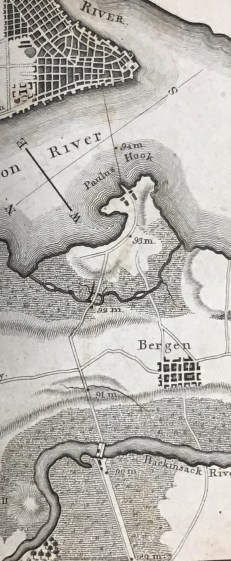
The first task was to survey potential new routes; the second was to promote them to investors. Beginning from the court house in Newark, surveyor Casimir Goerck laid out three possible routes more northerly than the present road, and a fourth route “by the present Road shortned.” A copy of Goerck’s map in the possession of John Pintard, one of the two New York commissioners, was given to an engraver, and published in The New-York Magazine; or, Literary Repository: for July, 1791, with tables of distances and river breadths and depths at the proposed crossings, the commissioners not having yet settled on the bridges’ locations.9
Existing ferry landings were included on the map as possible sites for bridges, but the three new routes all crossed the Passaic at places further upstream: Beef Point on the eastern edge of Newark Neck, Hedden’s Dock and Camp’s (later Stone) Dock. They met at a single crossing of the Hackensack known as Douw’s Ferry. Discovering the engraved map after nearly a half-century, Whitehead took pencil and paper and executed an exact copy, which is preserved in one of his bound manuscripts at the New Jersey Historical Society.10
The route chosen was “that by ‘Hedden’s Dock’,” where today the Bridge Street bridge spans the Passaic River. It reached the Hackensack at Douw’s Ferry, in accord with the commissioners’ projection. An English visitor to Newark in 1794, when the Passaic River span was not yet complete and the Hackensack had yet to be bridged, described the former as “neatly framed of wood, with a draw bridge to let the schooners and other vessels pass.” It promised, he wrote, “to avoid the frequent disagreeable delays at this ferry,” and both bridges once finished would prove “a great convenience” to travelers to and from New York, and places adjacent.”11
At the time, however, there was just one daily stage, departing from Archer Gifford’s tavern in Newark at six in the morning and returning “to dinner, about three,” leaving one to wonder how many Newarkers yet saw the benefit of this “great convenience.” Indeed Whitehead, looking back over years of cataclysmic change along the length of this vital corridor, could comment that “the number of individuals then travelling daily in that one stage … are now represented by as many hundred.”12
Another visitor from abroad, the exiled Duke of la Rochefoucauld was anything but enthralled by the new road. Although he found the bridges to be “of strong and handsome construction,” the highway between them, through “exceedingly swampy ground,” was far too narrow and “very disagreeable to the traveller,” as it consisted of “trees having their branches cut away, disposed longitudinally, one beside another, and slightly covered with earth.” Nor could any but the most stoic traveler avoid mention of a still more disagreeable accompaniment to the journey: the road afforded no protection from the marshland’s ravenous mosquitoes.13
“To estimate duly present blessings or advantage,” wrote Whitehead, “it is well sometimes to let our thoughts rest upon other days….”14 It’s perhaps inevitable that those who pause to consider present ways of being and moving will measure them by the supposed standard of former times. That was a practice to which Whitehead acceded heartily, though with a historian’s insight and guardedness, but New York’s bonds with Newark entailed, for him, more than mere historical interest: his very being had its roots in those connections, and to them he owed his livelihood.
With an origin story uncannily similar to the more celebrated Hamilton’s (of British descent but born in the Leeward Islands, and taking ship while still a boy to try his luck on the mainland), Whitehead’s father would seek safety for the members of his family during New York’s yellow fever outbreak of 1799, likely bringing them over the new road from Paulus Hook, only to lose his wife and oldest child as the epidemic touched Newark. Probably he made the same trip many times thereafter, both to court the young woman who became William’s mother, and to settle eventually in her hometown.15 In May 1804, stages between Newark and New York began running twice as frequently as a decade before: the coaches for New York left from an inn facing the bank that employed William’s father.16
Although these events predated Whitehead’s birth in 1810, they heralded the greater and swifter changes that came about as Newark assumed its pivotal place in a continent-wide transportation network. Happily or not, Whitehead was to be more than a witness to these changes: as the main route eastward became a road of iron and horse-drawn coaches yielded to fire-breathing locomotives, he found, even in himself, the means to set the earth to tremble.
Copyright © 2023-2026 Gregory J. Guderian
[1] G. P., “Old times–Communication with N. York,” Newark (N.J.) daily advertiser 3 September 1839 2:3-4, hereafter “G. P., ‘Old times’”; William A. Whitehead, East Jersey under the Proprietary governments: a narrative of events connected with the settlement and progress of the province, until the surrender of the government to the Crown in 1702 [1703] (Collections of the New Jersey Historical Society, 1. Hereafter “Whitehead, East Jersey”) ([New York] 18461) 160, (Newark 18752) 234; William A. Whitehead, Contributions to the early history of Perth Amboy and adjoining country, with sketches of men and events in New Jersey during the provincial era (New York 1856; hereafter “Whitehead, Contributions”) 270-271.
[2] Samuel Allinson, comp., Acts of the General Assembly of the Province of New-Jersey, from the surrender of the government to Queen Anne, on the 17th day of April, in the Year of our Lord 1702, to the 14th day of January 1776, to which is annexed the ordinance for regulating and establishing the fees of the Court of Chancery of the said Province (Burlington, N.J. 1776; hereafter “Allinson, Acts”) 276-279; G. P., “Old times”; Whitehead, Contributions 286-289.
[3] In what I think was a rare misunderstanding of the historical record, Whitehead saw the Passaic River ferry at Newark, forming “part of the main route to New York,” as having evolved from a “Transporting place” mentioned in an act of 1718. In that year, the New Jersey Assembly determined that one of two competing roads, “beginning at the Transporting place on Passaick River,” should “be and remain the publick Road.” Whitehead believed that to the course of this road corresponded “in whole or in part” a later one “leaving Newark from the south end of the town” and running easterly, crossing the meadows and the lower Passaic, then continuing on “a straight causeway” to the Hackensack on its way to meet the road from Bergen Point. A scrutiny of the 1718 act, however, indicates that the disputed roads served farms only in north New Barbadoes Township, and never extended to the Hackensack River. The “Transporting place” was likely at Acquackanonk Landing, the future city of Passaic. G. P., “Old times”; Whitehead, Contributions 272, 285-286; Samuel Nevill, The Acts of the General Assembly of the Province of New-Jersey, from the time of the surrender of the government in the second year of the reign of Queen Anne, to this present time, being the twenty fifth year of the reign of King George the Second ([Philadelphia] 1752) 91-92. Cf. William W. Scott, History of Passaic and its environs (3 vols. New York and Chicago 1922) 2:889-890; Norman F. Brydon, The Passaic River. Past, present, future (New Brunswick, N.J. 1974) 183-185.
[4] Whitehead noted, in passing, a 1772 allocation of funds “for covering with gravel a very long Causeway through a Swamp and over the Meadows and Marshes on New Barbados Neck,” which appears to have connected the bridge at Second River (Belleville) to “the Road to and from New-York by Paulus-Hook”: Allinson, Acts 385, cited in G. P., “Old times,” and Whitehead, Contributions 286. The construction was credited to Col. John Schuyler, a proprietor of the Second River copper mines. Chief Justice Joseph C. Hornblower shared his father’s recollections of laying out this route ca. 1765, when “the cedar thicket was so dense that a way had to be cut with axes, and lanterns used in the day-time, in making the survey.” William Nelson, “Josiah Hornblower, and the first steam-engine in America, with some notices of the Schuyler copper mines at Second River, N. J.,” Proceedings of the New Jersey Historical Society (hereafter “Proceedings”) ser. 2, 7:4 (1883) (175-247) 203-204n.
[5] Trustees hoped that “short and easy Access … to the Markets of the City of New-York” and the “general Benefit both to the City and Country” would attract widespread support, “more especially since by said Law the publick Interest alone is regarded.” William Nelson, ed. Documents relating to the colonial history of the State of New Jersey. Extracts from American newspapers, relating to New Jersey, 5. 1762-1765 (Archives of the State of New Jersey [hereafter “NJA”] ser. 1, 24. Paterson, N.J. 1902) 560-561.
[6] [Joel Barlow, tr.,] New travels in the United States of America. Performed in 1788, by J. P. Brissot de Warville (Boston 1797) 97, quoted in G. P., “Old times,” and Whitehead, Contributions 287. The French text reads: “toute construite en bois, avec tant de peine et de constance, au milieu des eaux, sur un terrain mouvant, elle prouve à quel point peut s’élever la patience de l’homme qui veut vaincre la nature.” J. P. Brissot (Warville), Nouveau voyage dans les États-Unis de l’Amérique Septentrionale, fait en 1788 (3 vols. Paris 1791) 1:258.
[7] G. P., “Old times”; Whitehead, Contributions 287.
[8] “An Act for building Bridges over the Rivers Passaick and Hackinsack, and for other purposes therein mentioned,” Acts of the fifteenth General Assembly of the State of New-Jersey. At a session begun at Burlington the 26th day of October, 1790, and continued by adjournments. Being the first sitting (Burlington, N.J. 1790) 685-692. One of the five road commissioners, John Pintard of New York City, was also a major stockholder in the S.U.M. and an agent of its governor, William Duer; another, John Neilson of New Brunswick, was a sometime S.U.M. director. Ruined in the 1792 financial panic brought about in part by Duer’s speculative excesses, Pintard was imprisoned in Newark for more than a year for debt; in the next century his fortunes and reputation were sufficiently restored, and he was active in numerous commercial, philanthropic and educational organizations. The New-York Historical Society, established in 1804, owes its existence to his efforts. Another S.U.M. director, John Noble Cumming of Newark, would influence the progress of the Newark-Paulus Hook road through his involvement in several related companies. The S.U.M. conducted business mainly in Newark before settling definitively at Paterson. See Richard A. Harrison, Princetonians 1776-1783. A biographical dictionary (Princeton 1981) 89-99; Joseph Stancliffe Davis, Essays in the earlier history of American corporations (2 vols. Cambridge, Mass. 1917; repr. 1965), esp. 1:296, 316, 390-394, 425, 2:206, 285; and my earlier post 031–Speed.
[9] Drawn by J. Anderson and engraved by Cornelius Tiebout, the map is number 3220 in David McNeely Stauffer, American engravers upon copper and steel (2 vols. New York 1907) 2:580. It was inserted in The New-York Magazine of July 1791, with the description and tables on 367-368.
[10] Whitehead dated his copy, a tracing on translucent paper, 10 April 1839. By then he had resided in New York, where the copy was most likely made, for about six months. It is found in a volume in William A. Whitehead Papers, Manuscript Group 177, New Jersey Historical Society. Whitehead “exhibited” his facsimile at the Society’s May 1849 meeting, during a discussion of the bridges and road between Newark and Paulus Hook. Proceedings [ser. 1] 4:1 (1849) 5-6. His earliest print reference to the map, in September 1839, was repeated in 1856: G. P., “Old times”; Whitehead, Contributions 287. I’ve found no indication that he intended to reprint it in any of his own works.
[11] Henry Wansey, The journal of an excursion to the United States of North America, in the summer of 1794. Embellished with the profile of George Washington, and an aqua-tinta view of the State House, at Philadelphia (Salisbury 1796; hereafter “Wansey, Journal”) 195, quoted in G. P., “Old times,” G. P., “Glimpses of the past in New Jersey. No. XIX,” Newark daily advertiser 4 June 1842 2:1-2, and Whitehead, Contributions 287-288.
[12] Wansey, Journal 196; G. P., “Old times.” Seventeen years later, Whitehead dutifully revised the count to “more than thrice as many hundred.” Contributions 289.
[13] Duke de la Rochefoucault Liancourt, Travels through the United States of North America, the country of the Iroquois, and Upper Canada, in the years 1795, 1796, and 1797 (4 vols. London 18002) 2:361, and Wansey, Journal 98, both quoted in G. P., “Old times,” and Whitehead, Contributions 287-288, where the mosquitoes’ tenacity is classified among “the delights of the road.” The causeway was “made passable by sticks of timber laid across it all the way, so close together, that the horses cannot step between.” Wansey, Journal 198.
[14] G. P., “Old times.”
[15] For the circumstances that brought Whitehead’s father to Newark, see my earlier post 025–In a country town.
[16] “Newark stage,” Centinel of freedom (Newark, N.J.) 1 May 1804 3:4, 8 May 1804 1:1. William Whitehead was elected the bank’s first cashier on the 19th of the same month: Centinel of freedom 22 May 1804 2:4.
 An attractive presence