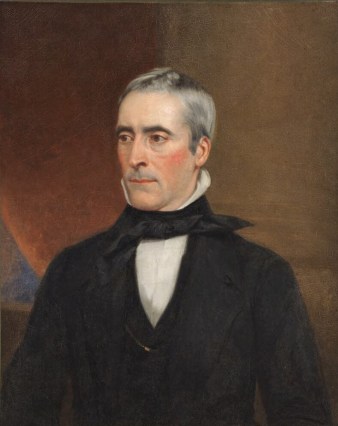
IN the opening pages of The History of the Rise and Progress of the United States of North America, James Grahame wrote of the “grateful exultation” an American might feel, born in “a land that has yielded as great an increase of glory to God and happiness to man, as any other portion of the world, since the first syllable of recorded time, has ever had the honour of producing.”1
To characterize the nation’s “rise and progress” in these sweeping terms would have raised scarcely an eyebrow. Governments had long laid claim to divine purpose, even to heavenly origins, and the pursuit of happiness was enshrined in the very founding document of the republic. Grahame’s opinion suited the strong nationalistic sentiment of the decades after the War of 1812. But some would be surprised to learn that these were not the words of a native of the United States; they came from a subject of the realm against which previous generations of Americans, in two successive wars, had fought for and secured their independence.
Grahame esteemed America so highly not out of an uncritical patriotism but from a fervent belief in its promise. The piety he felt toward a land he would never see sprang out of a liberal spirit imbibed from his reform-minded father and his father’s acquaintances.2 They found common cause in the British antislavery movement, so that it became impossible for Grahame, even as he strove to record its gains won for God’s glory and human happiness, to ignore the young nation’s foremost failing.
Born in Glasgow in 1790, Grahame trained as an attorney and was admitted to the Scottish bar in 1812. But his “naturally active and discursive” mind, it was said, “could not be circumscribed within the sphere of professional avocations.” Fusing religious principles with a sympathetic interest in the westward migrations of British Nonconformists, he came to view the “grand and noble” field of American history as a religious calling, “a service of body and spirit to God.”3
To write in Europe a history of the distant American colonies was then no easy enterprise, made more difficult by Grahame’s chronic ill health. But having wrestled “with many doubts, and after frequent misgivings,” he embarked on “the most interesting historical subject, I think, a human pen ever undertook”: the annals of North America from the first European settlements to the founding of the United States.4
In time Grahame gave up the legal profession as unsuited to his temperament, and conducted much of the research and writing for his history on the continent. Works unavailable in Britain he found in the great library of Göttingen, and moving to the more salutary climate of Nantes in the valley of the Loire allowed him “to labor night and day at his historical work….”5
The first fruits of that labor, two volumes published in London in 1827, traced the colonies’ history down to 1688. For some years, Grahame’s work was hardly noticed on either side of the Atlantic, but he persevered in revising and extending it, gathering material for another two volumes that would bring the narrative down to the beginning of the American Revolution. The new version didn’t appear, however, for nearly a decade after its predecessor, and Grahame saw no monetary gain from either.6
The work came to the notice of William A. Whitehead, probably through a critical essay published in the North American Review in early 1831.7 After a chronicler of New Jersey history adopted Grahame’s stirring words quoted above (in an 1834 compendium that also copied heavily from Grahame), Whitehead found good reason to form his own direct acquaintance with the Scottish historian.8
Whitehead’s isolation from European archives and the colonial records they contained may have caused him to look with sympathy on one “writing in a foreign land, removed from many sources of original information….”9 Still, he was much indebted to Grahame for bringing one crucial source to his attention: The Model of the Government of the Province of East-New-Jersey, a very rare compilation printed in Edinburgh in 1685, revealed much about the province’s early settlement that was “nowhere else to be found.” Until Whitehead located a copy of the text, transcribing and republishing it as an appendix to his own history, Grahame had been the only author to give “any particular notice of its character, or of the circumstances under which it was written….”10
An American reviewer had, in 1832, faulted Grahame’s History for one or two unjust remarks and insinuations about the leaders of the Rhode Island and Pennsylvania colonies, but he had been pleased to find in Grahame no “want of readiness to acknowledge the bravery and the merits of the founders of our states.”11 In the same year, that reviewer commenced his own historical labors, efforts whose popular appeal would overtake Grahame and all others in the field.
George Bancroft’s History of the United States from the Discovery of the American Continent began appearing in 1834. It would extend to ten volumes and a score of editions.12 Grahame and Bancroft both celebrated America’s progress, both conceived of its history in terms of a divine plan. But, for Bancroft, the religion of the colonists was in some respects incidental: his core principle of “freedom of mind” and his portrayal of the United States as the embodiment of that ideal harmonized perfectly with the democratic currents of the age.13 Historian William H. Prescott, a friend to both men, conceded that although Grahame had produced “a truly valuable” history he was still a foreigner, unable to “comprehend all the minute feelings, prejudices, and peculiar ways of thinking, which form the idiosyncrasy of the nation.”14 The native-born Bancroft, it seems, wrote history as most Americans wanted to read it.
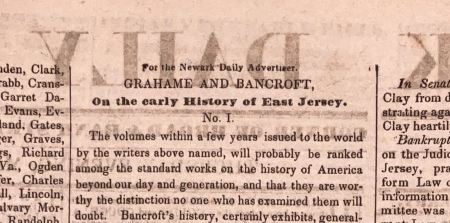
A passage of Bancroft’s seeming to reproach Grahame for dishonesty caused a feud to erupt between the two, of which neither man could bring himself to seek a reconciliation. The bitterness of it would persist, after the death of Grahame, between his acolytes and Bancroft.15 But in the spring of 1840 the rivals were united, at least in name, by the running title Whitehead gave a series of historical articles he contributed to Newark’s daily newspaper.
In the first installment of “Grahame and Bancroft, on the Early History of East Jersey,” Whitehead disavowed any intention of criticizing or comparing the two authors: he wished only “to point out some errors into which both have fallen” in their respective treatments of the province’s history, while still making allowance for the “little variety of original information” available to them. Comparisons, however, were inevitable. Considering that Grahame and Bancroft largely drew on the same sources, Whitehead judged the latter’s handling of New Jersey affairs “exceedingly unsatisfactory if not superficial.”
Having no aspirations beyond the history of his native state, Whitehead was bound to admire both men for productions sure to figure “among the standard works on the history of America beyond our day and generation….” But in one crucial respect he preferred the British historian to his American “competitor.” Grahame, working at a distance from the maelstrom of American politics, appeared to him “unbiassed by the views of any party or by the different opinions on the subject of government, which exist among us….” Grahame’s aim seemed to be “the obtainment of truth,” not the marshalling of facts to support a given theory. Bancroft, in contrast, had an obvious agenda, and wrote “with a view to uphold certain preconceived opinions”; he presented “facts and arguments … in hues infused by the operation of the author’s mind, instead of wearing their native coloring….”16
Whitehead didn’t care to explore these biases, but in eight successive newspaper columns over five weeks, he detailed a litany of Bancroft’s mistakes in the treatment of colonial New Jersey, beside a mere handful of errors imputed to Grahame. Most of Grahame’s slips, in fact, could be blamed on the printed works he relied on, causing one to marvel that his “task was performed so well.”
Whitehead’s columns eventually found their way to Grahame in Europe, who returned thanks for their criticisms. “Wherever I find myself convicted of error, however slight,” he wrote, “I shall honestly correct and unashamedly confess it.”17 Not long after, Whitehead had to confess to minor lapses of his own, occasional carelessness having led him to make incorrect assertions about the accuracy of Grahame’s work.18 “I plead guilty,–being unequivocally wrong,” he admitted in one instance. “I feel no desire to claim the name or character of a ‘critic,’ my only wish being for light sufficient to enable me to plod my way through the obscurity of the past until I may at last attain historical truth.”19
Whitehead so admired Grahame that he even dared hope the colonial records in English archives, then off-limits to himself, would one day be subject to “the ability, research, and candor of that distinguished writer….”20 But his wish was to go unfulfilled. Grahame died in July 1842, aged 51, while seeing through the press his pamphlet Who Is To Blame?, a passionate exposition of “the injustice and absurdity” of holding the mother country accountable for the continued existence of slavery. Among those who perpetuated this delusion he counted George Bancroft, calling him “a systematic flatterer and soother of every reigning prejudice of his countrymen….”21
To the end, Grahame championed “the obtainment of truth” as he saw it, but he regretted to see truth “so lightly esteemed by writers of the present day.” Truth, he believed, was the “most important requisite” of historical writing, “of which even the sincerity of the historian is insufficient to assure us.”22 Whitehead appears to have found at least a part of his historian’s credo in such “uncompromising regard for rigid truth and accuracy….” But when all that remained of Grahame were his works and memory, Whitehead indulged a more tender longing, “without neglecting the historian,” to read and learn more of “the man, … to live over again as it were … the life which seems to have been so much ‘without spot or blameless’”23: a desire no doubt reflective of what the New Jersey historian perceived as the oneness of historian and man, and the sacredness of his calling.
Copyright © 2024-2026 Gregory J. Guderian
[1] James Grahame, The history of the rise and progress of the United States of North America, till the British revolution in 1688 (2 vols. London 1827. Hereafter “Grahame, The history [1827]”) 1:viii-ix.
[2] On Robert Grahame of Whitehill, see Biographical sketches of the Hon. the Lord Provosts of Glasgow. With appendix (Glasgow 1883), republished as The Lord Provosts of Glasgow from 1833 to 1902. Biographical sketches, with a chronological record of the chief events in the city’s history during that period (Glasgow 1902) 12-23.
[3] Josiah Quincy, Memoir of James Grahame, LL. D., author of The History of the United States of North America (Boston 1845; hereafter “Quincy, Memoir”) 9-10, 13-15; James Grahame, The history of the United States of North America, from the plantation of the British colonies till their assumption of national independence (4 vols. Boston 1845. Hereafter “Grahame, The history [1845]”) 1:xi, xv-xvi.
[4] Quincy, Memoir 14-15; Grahame, The history (1845) xvi-xvii.
[5] Grahame, The history (1827) 1:vi-vii; Quincy, Memoir 16, 18, 21-22; Grahame, The history (1845) xviii-xix, xxiii.
[6] James Grahame, The history of the United States of North America, from the plantation of the British colonies till their revolt and declaration of independence (4 vols. London 1836. Hereafter “Grahame, The history [1836]”). “My first publication,” Grahame wrote to the U.S. consul in London of the 1827 edition, “fetched me not a farthing of profit–and the second has cost me about £600.” J. Grahame, L’Éperonnière, Nantes 8 June 1837, to Col. Thomas Aspinwall. Boston Public Library, Special Collections, MS 471.
[7] The North American review 32:70 (January 1831) 174-195. The critique of Grahame’s work by Charles F. Adams was detailed and highly favorable, with this qualification: “We do not mean to say, that he has invariably avoided error; but that he has coped very successfully with the disadvantages of his situation. His mistakes occur, in allusions to habits and customs which he cannot know. They are such as might be expected from every stranger not acquainted with us by personal observation, who, the moment he leaves his books, loses his only undeviating guides.” Ibid. 180. William H. Prescott wrote similarly of Grahame a decade later: see note 14.
[8] Thomas F. Gordon, The history of New Jersey, from its discovery by Europeans, to the adoption of the federal Constitution (Philadelphia 1834) 3. According to Whitehead, “Gordon was so well pleased with Mr Grahame’s epitome of N. J. History that he has transferred much of it verbatim, notes, errors, and all into his book! In one place there are 7 successive pages almost word for word with Mr G’s. 2d volume, with the exception of about 70 lines.” G. P., “Grahame and Bancroft, on the early history of East Jersey. No. I,” Newark (N.J.) daily advertiser 19 March 1840 2:4 (hereafter “G.P., ‘Grahame and Bancroft … No. I’”).
[9] G.P., “Grahame and Bancroft … No. I.”
[10] William A. Whitehead, East Jersey under the Proprietary governments: a narrative of events connected with the settlement and progress of the province, until the surrender of the government to the Crown in 1702 [1703] (Collections of the New Jersey Historical Society, 1. Hereafter “Whitehead, East Jersey”) ([New York] 18461) 233-234, (Newark 18752) 359-360. Whitehead quoted approvingly Grahame’s characterization of the Scots colonizers of East Jersey, who “enriched American society with a valuable accession of virtue that had been refined by adversity, and piety that was invigorated by persecution.” Grahame, The history (1827) 2:358; Whitehead, East Jersey (18461) 105 and cf. 235, (18752) 138 and cf. 361. For Whitehead’s republication of The Model of the Government of the Province of East-New-Jersey in America, see my earlier post 053–Scot’s Model.
[11] The American quarterly review 12:24 (December 1832) (426-441) 430.
[12] I here cite only the first edition of volume two: George Bancroft, History of the United States, from the discovery of the American continent (Boston and London 1837; hereafter “Bancroft, History [1837]”). For characterizations of the work and its publication history, see J. Franklin Jameson, The history of historical writing in America (Boston and New York 1891) 100-108; J. Clay Walker, George Bancroft as historian (Diss. Heidelberg 1915) 24-31; Michael Kraus, The writing of American history (Norman, Okla. 1953) 117-127.
[13] Longevity, too, was on Bancroft’s side: he died at age 90, having devoted a half-century to his History and having, in his 80s, seen through the press a six-volume reissue designated “The Author’s Last Revision,” itself several times reprinted. Bancroft saw, in the Protestant Reformation, “the common people awakening to freedom of mind.” Bancroft, History (1837) 2:456; cf. 2:465. For the development of his religious thinking see Russel B. Nye, “The religion of George Bancroft,” The journal of religion 19:3 (July 1939) 216-233.
[14] William H. Prescott, “History of the United States from the Discovery of the American Continent. By George Bancroft. Vol. III. Boston. Charles C. Little and James Brown. 8vo. pp. 468,” The North American review 52:110 (January 1841) (75-103) 84, reprinted as “Bancroft’s United States. January, 1841,” in id., Biographical and critical miscellanies (New York 1845) (294-339) 309. Grahame responded to the criticism in his private journal: “I think a man may better describe objects, from not having been inveterately habituated and familiarized to them; and at once more calmly contemplate and more impartially estimate national character, of which he is not a full, necessitated, born partaker,–and national habits, prejudices, usages, and peculiarities, under the dominance of which his own spirit has not been moulded, from its earliest dawn of intelligent perception.” Quoted in Quincy, Memoir 40; Grahame, The history (1845) xli.
[15] The long-running quarrel over the “baseness” Grahame perceived in the conduct of John Clarke as agent for Rhode Island colony, and Bancroft’s charge of “invention” on the part of Grahame, may be relevant here only for the insights it affords into the personalities of the principals. Chief among the published sources are: Bancroft, History (1837) 2:64 n2; Quincy, Memoir 33-35; Grahame, The history (1845) xxxv-xxxvii; Josiah Quincy, The memory of the late James Grahame, the historian of the United States, vindicated from the charges of “detraction” and “calumny” preferred against him by Mr. George Bancroft, and the conduct of Mr. Bancroft towards that historian stated and exposed (Boston 1846); “Bancroft and Grahame on Clarke of Rhode Island,” The historical magazine, and notes and queries concerning the antiquities, history and biography of America [ser.1] 9:8 (August 1865) 233-241. This last seems to derive its substance from a pamphlet prepared by Bancroft, John Clarke of Rhode Island and his accusers, which Robert C. Winthrop apparently dissuaded him from publishing. The New York Public Library holds corrected page proofs of this pamphlet (MssCol 196, George Bancroft Papers, Box 13) and two bound, but varying, versions. On page 5 of the latter, Bancroft promised “an exact documentary statement of the personal relations, which, very slight as they were, existed between Mr. Grahame and myself. It will be seen that much ado has been made about little or nothing.” See also Edmund Quincy, Life of Josiah Quincy of Massachusetts (Boston 1868) 477-479; M. A. DeWolfe Howe, The life and letters of George Bancroft (2 vols. New York 1908) 1:238-240.
[16] G. P., “Grahame and Bancroft … No. I.” Grahame, to his credit, acknowledged the tendency of “partialities” to insinuate themselves in historical writing, as well as his own “strong predilection in favour of America, and the colonial side in the great controversies between her people and the British government…. Against the influence of this predilection, I hope I am sufficiently on my guard….” Grahame, The history (1827) 1:xi.
[17] “New Jersey history,” Newark daily advertiser 9 January 1841 2:2 (hereafter “‘New Jersey History’”). That Grahame received and acknowledged the columns is known from this unsigned editorial, which Whitehead preserved in one of his scrapbooks. Scrapbook Collection, Manuscript Group 1494, SB 10, New Jersey Historical Society, page 15. The first words of the piece–“A letter has recently been received by a friend from James Grahame, Esq.”–and a marginal note on the same page in Whitehead’s hand make it unclear whether he and Grahame corresponded directly or through Grahame’s Boston friend William H. Prescott. Four years later, Whitehead quoted from a letter of Grahame’s “now before the writer”; see note 22.
[18] Two of Whitehead’s minor corrections were disputed in a communication from Prescott, answered by Whitehead, both letters printed in the Newark paper: Newark daily advertiser 13 January 1841 2:3, 19 January 1841 2:1. Whitehead appears to have remained silent about another oversight: in the second of his “Grahame and Bancroft” columns, he felt bound to correct Grahame’s impression, from a failure to recognize the “old style” of dating then in effect, that “the first constitution of New Jersey,” the Concessions and Agreement published in February 1665, had been issued one year earlier than was the case. “This may be thought a small matter to comment upon,” wrote Whitehead, “but nothing relating to the origin of the document referred to is unimportant in the history of East Jersey.” G. P., “Grahame and Bancroft, on the early history of East Jersey. No. II,” Newark daily advertiser 19 March 1840 2:3-4. Grahame had indeed erred in his first edition (Grahame, The history [1827] 2:319n), but had removed the offending footnote in the second (cf. Grahame, The history [1836] 2:263-264).
[19] G. P., Newark daily advertiser 19 January 1841 2:1.
[20] G. P., Newark daily advertiser 19 January 1841 2:1. “We are pleased to find so able a writer as Mr. Grahame turning his attention so assiduously to American history, and especially since our own early annals are to be particularly dwelt upon. We hope he may be induced to examine with care the colonial and plantation offices of England in which there must remain much that is interesting and valuable.” “New Jersey history.” This unsigned piece I consider largely a statement of Whitehead’s thoughts, if not purely his production. We may presume it was Whitehead who excised from his scrapbook copy (see note 17) its description of his critique of Grahame as “careful and well considered….”
[21] James Grahame, Who is to blame? or, Cursory review of “American apology for American accession to negro slavery,” (London 1842) 42, 10n. A sentence taken from page 97 of this treatise was inserted in the 1845 Boston edition of Grahame’s History, immediately following the statement quoted at the beginning of this essay: “Were the dark and horrible blot of negro slavery obliterated from this scene, the brightness of its aspect would awaken universal admiration, and shed a cheering and ameliorating ray through the whole expanse of human nature and society.” Grahame, The history (1845) 1:lix-lx.
[22] “New Jersey history”; G. P., “‘Memoir of James Grahame, LL.D., author of The history of the United States of North America, originally prepared for the Collections of the Massachusetts Historical Society, by Josiah Quincy.’ Boston, 1845, pp. 51,” Newark daily advertiser 9 October 1845 2:1-2 (hereafter “G. P., ‘Memoir of James Grahame’”). The statement about truth in historical writing comes from Grahame, The history (1827) 1:ix.
[23] G. P., “‘Memoir of James Grahame’.” Almost two decades after its first appearance, Whitehead continued to esteem “Mr. Grahame’s valuable work” and looked with anticipation to its new American edition, “with the author’s last corrections. … The services of the gentlemen, who have been instrumental in procuring the republication of the work, cannot be otherwise than highly appreciated by every admirer of chasteness of style, perspicuity of arrangement, and fidelity of narration.” Whitehead, East Jersey (18461) 142 n29 (on 143).
 An attractive presence
One thought on “085–Light sufficient”