
IT could be said that, somewhere in the middle of the Atlantic Ocean, Richard Nicolls lost New Jersey.
At the behest of his royal master, James the Duke of York and of Albany, Colonel Nicolls went to assert England’s claim on a part of America then ruled by the rival Dutch. In August 1664, his well-armed warships came in view of woefully unprepared New Amsterdam, at the southern tip of Manhattan Island. Petrus Stuyvesant was persuaded to accept the enemy’s conditions, and the Dutch capitulated without a shot being fired. Nicolls renamed the settlement New York, after one of the Duke’s titles, and the colonel’s bloodless conquest of New Netherland meant that it remained–except for a short-lived restoration nine years later–in British hands for a century. Nicolls would learn to his dismay, however, that while he was at sea His Lordship had dismembered what was thought to be his government, bestowing a large portion of it elsewhere.
By a grant of King Charles his brother, the Duke had acquired a vast, if scattered, territory from Maine to Maryland, with few limits on his authority. Nicolls would administer the colony as James’s deputy, with an eye to keeping the peace and turning a profit for its owner. He laid out a liberal set of Conditions for New Planters to encourage settlement, and approved “several new purchases” of Indian lands west of the Hudson, a region that “to comprehend all the titles” of the Duke he christened Albania.
Unbeknownst to Nicolls, a month before the capture of New Netherland James had granted two loyal associates, Lord John Berkeley and Sir George Carteret, the entire tract south of a line drawn from latitude 41° 40´ on the Delaware to 41° on the Hudson, “hereafter to be called by the name or names of New Cesarea or New Jersey….” Nicolls had no knowledge of this deed until a year after the conquest, when Philip Carteret, a distant cousin of Sir George, arrived to take over as New Jersey’s first proprietary governor. Nicolls remained as governor of New York, but couldn’t conceal his dissatisfaction at the sacrifice of New Jersey. Within the grant to Berkeley and Carteret, he told James, lay “all the improveable part” of his domain, “capable to receive twenty times more people than Long Island and all the remaining Tracts….”1
Such, in bare outline, were the beginnings of New Jersey as an English province. Since the English in this part of America were as yet thin on the ground, those concerned in the colony’s success were not above inflating its virtues to tempt new settlers. “If,” began one idyllic portrayal, “there be any terrestrial happiness to be had by any people, especially of an inferior rank, it must certainly be here.” This and other panegyrics made only the slightest mention of the Dutch or the indigenous inhabitants. They also largely avoided what William A. Whitehead would call “the sober truths of reality….”2
A quest for the sober truths of New Jersey’s colonial past pulled Whitehead deep into one of the most obscure and most troubled chapters of its history. To gain some understanding of this period meant rummaging in “garrets and lumber-rooms of old homesteads,” sifting through “boxes and barrels” of discarded papers,3 longing for news and perhaps copies from overseas archives, and poring for hours over already published works by compilers and chroniclers, past and present.
Among contemporary scholars, George Bancroft loomed the largest by far. Born in Worcester, Massachusetts, in 1800, ten years before Whitehead, Bancroft outlived the younger man, dying in 1891. His life therefore spanned almost the entire century. He witnessed all the momentous events that Whitehead did, but the experiences, viewpoints and goals of the two differed markedly.
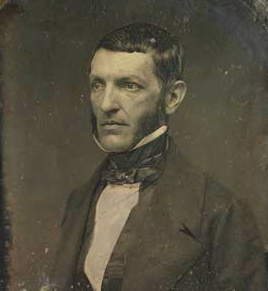
In contrast with Whitehead’s limited schooling, Bancroft was trained for the pulpit at Harvard and in Germany. He preached and taught before seeking more exalted status in politics and diplomacy. A leading light in the Massachusetts Democratic party, he was named to the powerful post of collector in the Boston customhouse, months before Whitehead gave up the same job at politically marginal Key West. He was the party’s nominee for governor of Massachusetts in 1844.
Bancroft’s subsequent service to Democratic administrations in Washington, as Navy Secretary and U. S. minister to London and Berlin, gave him resources and opportunities to extend his research to national and foreign archives. Whitehead had little taste for politics except as a tool to promote learning. His sole sojourn in Europe came in old age, when most of his historical work was behind him. Beyond his social and professional circles Whitehead was known but to a few. Bancroft became a household name as the foremost historian in America.
Whitehead must have encountered Bancroft first in that capacity, through the latter’s monumental History of the United States, from the Discovery of the American Continent. (Volume one, published in 1834, promised a chronicle of the nation’s progress “to the present time”; Bancroft dropped that phrase from the titles of volumes two through ten.) The second volume, appearing in 1837, contained the results of Bancroft’s investigations into the beginnings of New Jersey.4
Although the two men studied the same events and controversies, they diverged in their approaches, assumptions and conclusions. Whitehead’s work, unlike that of Bancroft, formed part of no grand national project. It drew none of the moral lessons Bancroft perceived in the advance of American democracy. While Bancroft philosophized, Whitehead sought to clarify particulars. His research uncovered points at which Bancroft’s nationalistic biases obscured the truth, much as close examination of a picture pleasing in its “general effect … may prove the details defective.”5
Whitehead was never so spartan as to reject fine style, be it others’ or his own. He complimented Bancroft’s history for its “beauty of composition rarely excelled,” and indulged himself on occasion in a picturesque narrative of events. He described Philip Carteret at the end of his long journey, “on a bright day in August” within sight of New Jersey, “navigating, with all the doubt and uncertainty of a voyager in unknown seas, the windings of the channel separating Staten Island from our shores.”6
But notwithstanding such flourishes, Whitehead preferred to think of himself as merely furnishing “materials for history,” not writing it. Unseen labor in the dark recesses of the past was needed to illuminate the larger picture: “Local histories and narrations are the wells,” he said, “whence the general historian must draw his facts,” and “in proportion as they are wanting must his labors be imperfect.”7
Bancroft seemed to Whitehead furthest from perfection in his treatment of the seventeenth-century clash between two colonizing systems. Richard Nicolls’s list of conditions was forward-looking for its time. It required that all land be bought from the Indians with a warrant from the governor, that all such conveyances be recorded, and that groups of purchasers lay out towns and dwell together. Settlers were to legislate for their communities and elect their own officers. Freedom of conscience was acknowledged. Taxes were deferred for five years. Perhaps most important, the purchasers’ lands became their own, to dispose of as they pleased. “These conditions,” Whitehead observed, “were of a liberal character,” enticing Puritan settlers from Long Island and New England to a region “so advantageously situated and susceptible of improvement at comparatively little cost.”8
With the arrival of Governor Philip Carteret came efforts to implement a different regime from that of Nicolls, its policies enshrined in a document known as The Concessions and Agreements. Like Nicolls, the proprietors sought to populate their colony, but the mechanisms for laying out lands, appointing officers and enacting laws were more tightly controlled. So too was liberty of conscience, guaranteed only to English subjects who swore allegiance to the King and faithfulness to the lords proprietors, provided they conducted themselves “peaceably and quietly and not using this liberty to Licentiousnes….”9
The Concessions attached the expected obligations to any grant of land not for public use or the use of the proprietors themselves: a warrant from the governor, a survey, and the recording of the deed. But a yearly payment was also demanded, fixed at a penny or halfpenny per acre: no provision was made for such a duty or tax on landholding, called a quit-rent, in Nicolls’s Conditions.

Five towns had already emerged out of land grants from Nicolls when Governor Carteret took charge in 1665. Carteret’s expectation of quit-rents seemed to cast doubt on the rights promised with the Nicolls grants, if not the very occupancy of the land they conveyed. When, after three years, the governor called the province’s first legislative assembly, the “seeds of dissension” had been sown.10 There was much friction between the governor and the towns, even before the first quit-rents came due at what was then the beginning of the year, 25 March 1670. But the arrival of that day, says Whitehead, awoke “the suppressed passions of those inimical to the existing government,” passions that exploded “at once in decided and violent opposition.”11
Landholders who withheld quit-rents or ignored other obligations under the Concessions faced losing their rights and their limited voice in the conduct of government. Matters came to a head in May 1672, when deputies from five towns convened without the governor’s authorization in Elizabethtown, electing as “president of the province” visitor James Carteret, whom Whitehead characterized as “a natural son of Sir George, a weak and dissipated young man….” The governor inveighed against the perpetrators of this coup, to limited effect. As Whitehead tells it, “the number and influence of his opponents prevented all proper enforcement of the laws,” and in July he sailed for England, to make his case in person to the proprietors.12
George Bancroft’s assessment of these tumults was manifestly more favorable to the rebels than to the governor. The “New England men” in the vanguard of the revolt believed that the Indians, being Noah’s “lineal descendants, had a rightful claim to their lands; … therefore a deed from the Indians was paramount to any land-title whatever….” Bancroft went on to depict the governor’s overthrow as a victory of the people, in which
disputes were followed by confusion; the established authority fell into contempt; and the colonists, conscious of their ability to take care of themselves, appointed their own magistrates and managed their own government. Philip Carteret withdrew to England, leaving the colonists to domestic peace.13
Whitehead was aghast: “conscious of their ability to take care of themselves”? What of the obligations that came with settlement? What of the oaths of allegiance they had taken? their past regard for the Concessions as “sacred and irrevocable”? the “implied faith” in their past compliance with its terms? Were these “of so little moment that they could be thrown off at pleasure?” Reacting against Bancroft’s blithe pronouncements, Whitehead put a question to his readers, boldly and grandly: “Is the writer in sober truth disposed thus lightly to treat of broken faith, insurrection and injustice?” And he demanded, pointedly: “Is this history?”14
Bancroft had found in the records a palliative, in case any was needed, for the upset of New Jersey’s established order: “Puritan austerity was so tempered by Dutch indifference,” he said, that even as they drove out the governor “the people were humane,” respecting his person and property. Whitehead was rather skeptical, pointing out that members of Carteret’s council were not treated as gently.15
In later editions of Bancroft’s second volume, his position moderated; his more audacious statements on the proceedings of 1672 were quietly suppressed.16 This came about, Whitehead remarked, once the author recognized “the manifest impropriety of regarding them in any thing like a favorable light.” If such was the case, the silent retraction was of Whitehead’s making, and therefore “gratifying to every Jerseyman….”17
More crucial than this small vindication, and perhaps more open to debate, is Whitehead’s view of the assertion of proprietary rights that instigated the crisis. The proprietors understood all the powers granted to the Duke to have devolved to them, “including, as was conceived, the right of government, although not expressly designated,” and thought they could command the very same obedience from New Jersey’s inhabitants.
Transfer of such authority from the King or the King’s heir to another party was “little in accordance with modern ideas of what constitute the just rights of mankind….”18 It may well have lacked legal foundation even in its own day. To Whitehead, however, subversion of the constitutional order would seem equally indefensible.
At least two items of correspondence passed between Whitehead and Bancroft in 1846. While the latter waited in Washington for news of a diplomatic appointment overseas, the New Jersey Historical Society elected him an honorary member. It fell to Whitehead, the Society’s corresponding secretary, to notify recipients of this distinction. Bancroft’s acknowledgment was received and recorded, and a copy of it survives. No other evidence of contact between the two men has come to light.19
Copyright © 2024-2026 Gregory J. Guderian
[1] William A. Whitehead, East Jersey under the Proprietary governments: a narrative of events connected with the settlement and progress of the province, until the surrender of the government to the Crown in 1702 [1703] (Collections of the New Jersey Historical Society, 1. Hereafter “Whitehead, East Jersey”) ([New York] 18461) 36-37, 180, (Newark 18752) 41-42, 262-264; William A. Whitehead, ed. Documents relating to the colonial history of the State of New Jersey. 1. 1631-1687 (Archives of the State of New Jersey, ser. 1, 1. Newark 1880 [hereafter “NJA, ser. 1, 1”]) 3-14, 20-25, 46-48.
[2] Whitehead, East Jersey (18461) 13, 175, (18752) 13-14, 257.
[3] G. P., “Grahame and Bancroft, on the early history of East Jersey. No. VIII,” Newark (N.J.) daily advertiser 10 April 1840 2:3.
[4] George Bancroft, History of the United States, from the discovery of the American continent 2 (Boston 18371. Hereafter “Bancroft, History 2”). Starting in 1837, the first three volumes of Bancroft’s magnum opus bore the alternate title History of the colonization of the United States, many editions having two title pages.
[5] G. P., “Grahame and Bancroft, on the early history of East Jersey. No. I,” Newark daily advertiser 12 March 1840 2:4 (hereafter “G. P., ‘Grahame and Bancroft, No. I’”).
[6] G. P., “Glimpses of the past in New Jersey. No. VII.–Gov. Carteret,” Newark daily advertiser 2 April 1842 2:1-2 (hereafter “G. P., ‘Glimpses of the past, No. VII’”). Whitehead’s later recounting of Governor Carteret’s arrival is decidedly less evocative: cf. Whitehead, East Jersey (18461) 36, (18752) 40-41.
[7] G. P., “Grahame and Bancroft, No. I”; Whitehead, East Jersey (18461) v-vi, (18752) v-vi.
[8] Whitehead, East Jersey (18461) 37, (18752) 42.
[9] “The Concessions and Agreements of the Proprietors of East Jersey,” in NJA, ser. 1, 1:28-43.
[10] G. P., “Grahame and Bancroft, No. VII”; Whitehead, East Jersey (18461) 52-53, 188-189, (18752) 59-60; “Proclamation of Governor Carteret, calling the first Assembly,” in NJA, ser. 1, 1:56-57.
[11] G. P., “Grahame and Bancroft, on the early history of East Jersey. No. II,” Newark daily advertiser 19 March 1840 2:3-4 (hereafter “G. P., ‘Grahame and Bancroft, No. II’”); Whitehead, East Jersey (18461) 54, (18752) 64.
[12] G. P., “Grahame and Bancroft, No. II”; Whitehead, East Jersey (18461) 55-57, (18752) 67-69. In the second and revised edition of his East Jersey, Whitehead omitted the qualifier “natural,” having found no convincing proof of James Carteret’s illegitimacy. Cf. Proceedings of the New Jersey Historical Society (hereafter “Proceedings”) ser. 2, 1:1 (1867) 23.
[13] Bancroft, History 2:318-319.
[14] G. P., “Grahame and Bancroft, No. II”; Whitehead, East Jersey (18461) 33 and cf. 54-55, (18752) 37 and cf. 64-65.
[15] Bancroft cited records of the Dutch interregnum indicating that the governor’s property was not confiscated but “sacredly respected”: Bancroft, History 2:319. Whitehead pointed out the contrasting treatment of William Pardon, a member of the governor’s council who, refusing to give up the acts of the Assembly, was arrested and subsequently escaped from custody. James Bollen, the provincial secretary, was also arrested and escaped. “The puritanical spirit” manifested in East Jersey penal laws, according to Whitehead, having “no less than thirteen different offences subjecting the offender under certain circumstances to death,” also contradicted the “humanity” alleged by Bancroft. G. P., “Grahame and Bancroft, on the early history of East Jersey. No. III,” Newark daily advertiser 23 March 1840 2:1-2 (hereafter “G. P., ‘Grahame and Bancroft, No. III’”); cf. Whitehead, East Jersey (18461) 56 n.66, 62 n.82, 163-164, (18752) 68 n.4, 77 n.2, 238-240; NJA, ser. 1, 1:104. See also G. P., “Glimpses of the past, No. VII.”
[16] Bancroft’s revised text, appearing first in the abridged 1841 edition, reads as follows: “disputes were followed by confusion; and, in May, 1672, the disaffected colonists, following the impulse of independence rather than of gratitude, sent deputies to a constituent assembly at Elizabethtown. By that body Philip Carteret was displaced, and his office transferred to the young and frivolous James Carteret. The proprietary officers could make no resistance. Following the advice of the council, after appointing John Berry as his deputy, Philip Carteret hastened to England in search of new authority, while the colonists remained in the undisturbed possession of their farms.” George Bancroft, History of the colonization of the United States (2 vols. Boston 1841) 2:319. The tenth edition also removed Bancroft’s exculpatory reference to Dutch records (see note 15 above), further qualified James Carteret as “a natural son of Sir George,” and conceded that “William Pardon, who withheld the records, found safety only in flight.” George Bancroft, History of the United States from the discovery of the American continent (Boston 184210) 2:319.
[17] Even after “materially changing the character of his remarks” in later editions, Bancroft remained an object of Whitehead’s censure for “research … so much at fault…. Alas! for the teachings of history, if broken faith, insurrection and injustice can be thus lightly passed over.” Whitehead, East Jersey (18461) 56 n.66. Newark pastor Jonathan F. Stearns stood by Bancroft, “very sorry, if, as Mr. Whitehead observes, he was induced to change his mind….” Justice, “Proceedings in 1672–Defence of rights not insurrection–No. 1,” Newark daily advertiser 19 March 1855 2:5-6. Whitehead suppressed these criticisms in his second edition: Whitehead, East Jersey (18752) 69 n.1.
[18] Whitehead, East Jersey (18461) 32, (18752) 36.
[19] Proceedings [ser. 1] 1:4 (1846) 173, 174. George Bancroft, Washington 19 May 1846, to W. A. Whitehead, George Bancroft Papers, Massachusetts Historical Society, Ms. N-1795, Box 15/7. Five years later, Bancroft attended a meeting of the New Jersey Historical Society at which Whitehead also was present. He delivered an address on the “Origin of the American Union.” Proceedings [ser. 1] 5:4 (1851) 164.
 An attractive presence
2 thoughts on “086–Seeds of dissension”