DEPENDENCE for a living on a share of the national revenue, its continuance threatened only by the “periodical terrors” of a quadrennial election, is an affliction that most government functionaries somehow manage to endure. But in the custom house surveyor who will unwind the tale of Hester Prynne and the Scarlet Letter, his character a mirror image of the customs officer Nathaniel Hawthorne in real life twice became, it awakens a troubling consciousness of his intellectual and moral decline.
Hawthorne’s surveyor draws his share of “Uncle Sam’s gold” from the industry of others. His fellow officers, most of them old seafarers, tilt indolently in chairs against the custom house walls. They think and talk little of “all the world’s wonders which they had witnessed with their youthful eyes,” more eager to discourse upon “their morning’s breakfast, or yesterday’s, to-day’s or tomorrow’s dinner….”
In the company of such men, all ostensibly sworn to the service of “our common Uncle,” the surveyor who once cherished literary aspirations finds himself devoid of all interest in reading or writing: “Literature, its exertions and objects, were now of little moment in my regard.” Unexpectedly, although inured to his situation and indifferent to politics, he finds deliverance with a change of administration in Washington, which precipitates his removal from office and permits his return to a writer’s life.
If the ambitions of Hawthorne’s or of any like-minded official were doomed within the tedious confines of the custom house, if a swift dismissal from one’s post was all that could rescue literary sensibilities from ruin, such a dread prospect–judging, at least, from his recollections of a half-century later–seems not to have occurred to William A. Whitehead on the day he assumed, at “age 20 yrs. 11 mos.,” the post of collector for the port of Key West.1
The business of entering and clearing shipments, calculating imposts and giving regular accounts of Key West’s contribution to trade and the nation’s revenue was a calling well-suited to Whitehead’s mathematical acumen and habits of efficiency and exactitude. But there were more worldly causes that brought him here. The business interests of his father, the owner of one-quarter of the island of Key West, and of his half-brother John, their father’s proxy and a commission merchant much invested in the commerce of its port, urged a dramatic improvement in the island’s reputation and relations with Washington, impaired as they were by the lapses of Whitehead’s predecessors, each of whom had been removed before the expiration of his term.
To the demands of his new employer, however, Whitehead allotted their due space and time, and no more. A small annex to the custom house served as his office, while he fitted up the main building as a comfortable residence. He took meals at Ellen Mallory’s boarding house but, unlike many unattached men in his situation, he slept at home. Under the custom house roof or on its veranda, he passed “whatever leisure hours or minutes were afforded me from business–and in those days there were many….”
Through his family ties, but also by virtue of his own industry, Whitehead at once became a pillar of the island’s tiny society, named a member of the town council within days of his arrival, and leading the campaign to endow the island with a church, a school and a “Minister of the Gospel.” Among merchants and other officials he “kept up a pleasant intercourse,” but with a self-discipline belying his years confined most of his free time to a “course of solid reading,” including every article in the four main “English Reviews.” On occasion, he indulged in “works of a lighter character” but reading them critically, “their errors noticed, and their beauties and moral teachings marked.”
Whereas the custom houses of Charleston and the major ports of the North labored under a century or more of norms and habits, and the entitlement and entrenchment of those on their payrolls, Key West’s years as a port of entry could still be counted in single digits. Furthermore the volume of its commerce was small, and in most instances a skeleton crew sufficed for its operations.
During Whitehead’s first month as collector, there was only one arrival in port of any moment, and it required no customs formalities. On 19 February 1831, which was Whitehead’s 21st birthday, the ship St. Louis entered the harbor “after a long & very boisterous passage of twenty days,” with a company of recruits from New York and materials for building army barracks, on a site still being negotiated with the island’s proprietors.2 A military presence had long been seen as essential to secure the port and its revenue, but the company and its commander, Major James Glassell, were not settled in permanent quarters until June.3
Glassell and his family were billeted during this time at the custom house, whose comforts Whitehead, much as he valued solitude, must have enjoyed sharing. The commander was frustrated, however, at its “inconvenient distance” from the soldiers’ encampment, which left the mostly raw recruits prey to all manner of temptation. Townspeople railed at their drunkenness and disorderly behavior, while Glassell struggled with indiscipline and the occasional desertion, and complained about civilians who encouraged and exploited his men’s weaknesses.4
Key West’s mainstay, the salvaging of cargo from passing vessels wrecked on the Florida Reef, dominated the meager business of its port in February 1831. The brig Mount Hope, the Cuba-bound schooner Toison and the brig Marcella were all guided into the harbor for repairs, although the latter two were judged total losses. Most of the cargo, including the nearly 1000 bales of cotton on Marcella, was saved.5
In March, the “shipping news” in the weekly Key West Gazette and newspapers in other ports indicate a decided increase in traffic, most of it still part of the wrecking trade, and some of that consigned to Whitehead’s brother John.6 But the collector’s business, too, saw a burst of activity, as sloops and schooners crisscrossed the Florida Strait between Key West and Cuba. “We observe by the marine list,” remarked the Charleston Courier, “that a very active intercourse appears to be carried on between Key West and Havana, in small vessels.”7 The contents of these holds had to be counted, measured and assessed duties at Whitehead’s custom house.
In quantitative terms, commerce originating or terminating at Key West made the place something of a Havana satellite. But sitting at the threshold of the Gulf of Mexico, the port acquired a significance out of proportion to its size, a quality Whitehead took great pains to document. Much of that documentation was lost long ago to environment, neglect, and a succession of natural and human-made disasters.8 Remarkably, the National Archives hold one impost book from Whitehead’s time–a bound folio in which he or his deputy logged every imported product together with the duties owed. The volume covers less than his entire tenure, beginning only in July 1831, and as books go can hardly be considered a page-turner.9
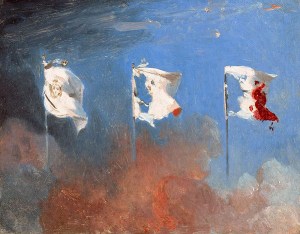
As more than 90% of the goods imported were carried in vessels of American registry, foreign arrivals were the more memorable. Two months into Whitehead’s collectorship the tricolor of France, an emblem only just revived by the Revolution of 1830, flew for the first time in Key West harbor aboard Emma, a French brig on its way from Havana to New Orleans. Proprietor P. C. Greene welcomed the visitor by unfurling its standard atop his own warehouse. A salute was fired, and all the ships in port hoisted their colors.10
Late in October, as the heat of summer softened, the revenue cutter Marion arrived from Charleston, with news that brought turmoil to the custom house and much of the island. On board were issues of the Courier, of which one, now a couple of weeks old, announced that another man had been appointed collector for Key West. There was a dispatch, too, from the Treasury Department, addressed to a Mr. Donelson Caffery, apparently the new holder of that office.11
Conscious of no grounds for complaint against Whitehead, the Key West Gazette declared him ever “indefatigable in his attention to his duties; we think his appointment one of the best made at this place.” The editors hoped the missive from the Treasury Department was a mere mistake.12 On receipt of the letter to Caffery, Whitehead took, we may guess, little time in writing to Washington with the same sincere wish.
In a subsequent issue the Courier gave the basis for its report: “Our information was derived from a dispatch from the Treasury Department, which casually fell under our notice.” Stephen Pleasanton, the Fifth Auditor of the Treasury and the official who received Whitehead’s inquiry, gave a more likely explanation and a reassuring one. The dispatch had passed through the custom house at Charleston, and the collector there must have allowed someone from the Courier to learn of it. The message, furthermore, had been misdirected, being intended for the collector of a port in Louisiana.13
Pleasanton had a correction inserted in the Washington Globe, and Whitehead himself notified the Courier of the error.14 In another month Whitehead would mark one full year as collector, and only a few small matters now stood in the way of his pleasant continuance. There was a shipment from Havana of ten gallons of wine, to be entered in the impost book on 21 November with the name “William A. Whitehead” as the consignee. And Pleasanton’s closing request also needed attention: “You will be pleased,” wrote he, “to desire the Post Master at Key West to return the letter for Mr. Caffery to this Office.”
Copyright © 2024-2026 Gregory J. Guderian
[1] The title “Childhood and youth of W. A. Whitehead 1810-1830,” assigned to Whitehead’s unpublished memoir, preserved in a transcription at the Florida Keys History Center, Monroe County Public Library, Key West, Florida, and at the P. K. Yonge Library of Florida, George A. Smathers Libraries, University of Florida, call number 00,207, strictly applies only to the first 28 of its 57 typewritten pages, but I have used “Childhood and youth” as shorthand for the entire work. Whitehead’s reminiscences of his arrival as collector and his activities in the first year are found on pages 29-32 of this transcription. See also my previous posts 039–Fishermen’s friend and, on the quest for a clergyman, 066–Accessions of much worth.
[2] J. M. Glassell, Key West 24 February 1831, to Col. Roger Jones, Letters received, Records of the Adjutant General’s Office, Record Group 94, National Archives and Records Administration (hereafter “Adjutant General’s Office, Letters received”), printed in Charles Edwin Carter, ed. The territorial papers of the United States. Volume XXIV. The territory of Florida 1828-1834 (Washington 1959; hereafter “Territorial papers XXIV”) 503-504 and see 504 n.68. Copies of correspondence between Glassell and the proprietors, forwarded to the Adjutant General in April 1831, are found in the same Record Group. Glassell united his 51 recruits to a detachment of the 4th Infantry on the island since 2 January: see Key West (Fla.) gazette 21-28 March 1831 2:3.
[3] From 1823 to 1826, the proprietors’ plans for Key West’s rapid development were thwarted by Commodore David Porter’s occupation; when the Navy withdrew to Pensacola, it left commercial navigation a prey to piracy. In 1828, Florida’s territorial legislature helped persuade the War Department to station an artillery company on the island “for the better protection of the revenue and inhabitants”: Acts of the Legislative Council of the Territory of Florida, passed at their seventh session 1828 (Tallahassee 1829) 300-301; Peter Buell Porter, Washington 24 December 1828, to Delegate Joseph M. White, printed in Territorial papers XXIV 124.
[4] J. M. Glassell, Key West 26 March 1831, to Col. Roger Jones, Adjutant General’s Office, Letters received. The U.S. law against aiding or abetting desertion from the army was printed in the island’s newspaper in English and Spanish, and Glassell offered a $15 reward for apprehending deserters: Key West gazette 20 April 1831 3:4, 27 April 1831 3:3 et seqq. Subsequent depredations committed by soldiers ignited a battle of words between Glassell and proprietor Pardon C. Greene, who brought the offences to the attention of the Secretary of War: see Territorial papers XXIV 743-744, 761-764, and cf. 795-797.
[5] Mount Hope was brought into port in early February with a small portion of its cargo lost and repairs needed; Toison and Marcella followed. Marine lists in the main newspapers give varying dates for these arrivals: see, inter alia, Key West gazette 21-28 March 1831 3:4; The Charleston (S.C.) courier 10 March 1831 2:2, 18 March 1831 2:4, 19 March 1831 2:3; Shipping & commercial list, and New-York (N.Y.) price current 9 March 1831 1:5; “From Key West,” City gazette & commercial daily advertiser (Charleston, S.C.) 14 April 1831 2:2. On the first day of March, “7 wrecking vessels out of 12” were at work on the Reef: William R. Hackley, Diary, in Goulding Collection, Special Collections, Florida State University Libraries, Tallahassee, MSS 0-128, entry of 1 March 1831. Key West received salvaged goods from Marcella and the ship Amulet aboard seven different wreckers in a single day (22 March): Key West gazette 21-28 March 1831 3:4. The University of Florida preserves papers from the salvage and repair of Mount Hope, including a report drawn up and signed by John Whitehead: P. K. Yonge Library of Florida, George A. Smathers Libraries, University of Florida, call number 01,153.
[6] John Whitehead, who had recently “re-established himself … in a general agency and commission business,” received four shipments of wrecked goods on 22 and 24 March: see Key West gazette 21-28 March 1831 3:4, 4:3.
[7] “From Key West,” Charleston courier 14 April 1831 2:2.
[8] A WPA survey estimated that a quarter of Key West custom house records had been lost to hurricanes and inadequate storage: The Survey of Federal Archives, Division of Community Service Programs, Work Projects Administration, Inventory of federal archives in the states. Series III. The Department of the Treasury. No. 9. Florida (Jacksonville, Fla. 1941) 73. This inventory found no records from before 1836. Early records kept at the Treasury Department were the casualty of a fire on 31 March 1833; on instructions from the Department, Whitehead and other collectors made copies of the correspondence files kept by their predecessors, and submitted these as partial replacements.
[9] Impost Books, 1831-1887, Record Group 36, Records of the Department of the Treasury, Customs Service 1745-1997, Collection District of Key West, Florida, Entry 1518, National Archives and Records Administration, vol. 1.
[10] Key West gazette 21-28 March 1831 2:3.
[11] Charleston courier 20 October 1831 2:2.
[12] Key West gazette 2 November 1831 2:4.
[13] Charleston courier 19 November 1831 2:3. Stephen Pleasanton, Treasury Department, Fifth Auditor’s Office, 28 November 1831, to William A. Whitehead; copy in Letters sent regarding lighthouses, 1792-1852, Record Group 26, Records of the U.S. Coast Guard, National Archives and Records Administration, Volume 9.
[14] The globe (Washington, D.C.) 26 November 1831 2:2; “Collector at Key West,” Charleston courier 21 November 1831 2:3.
 An attractive presence