ONE could fairly call William A. Whitehead a “provincial” historian, on the premise that he devoted a large share of his adult life to chronicling the past of one small American state–often of mere parts of it. Indeed, Whitehead might have humbly accepted the title, and not just because so much of his attention was drawn to New Jersey’s many years as a province of Great Britain. In the preface to East Jersey under the Proprietary Governments, his book-length study first published in 1846 and again in expanded form in 1875, he begged indulgence for what he thought must appear a superabundance of details: thus, “probably, marring the interest of his book to the general reader by giving it too precise a character….”
In his defense Whitehead declared, “The general historian must gather his facts from the details of local annals, and in proportion as they are wanting must his labors be imperfect.”1 Yet, however much his work might have informed a narrative of broader interest, or the questioning of one, nothing could be further from Whitehead’s aims than the writing of a sweeping national, much less a global history.
Concentration, however, needn’t beget isolation. From his earliest years, the turbulent wider world had made its presence known and, in the ways that he could, Whitehead embraced it. Once all formal schooling was firmly behind him, he made efforts between the ages of 15 and 20 to acquire some knowledge of French, then Spanish: skills that might serve his understanding of the ongoing rivalries among European powers, and the rise of the independent states of Latin America.
In truth, Whitehead made little headway with foreign languages: most of his knowledge of them was filtered through the British and American writings that were the mainstays of his reading life. But this would not hinder his later communion with other peoples or their ways. As collector of the revenue at Key West, he encountered mariners and officers from all over the Atlantic world, and made several missions to Spanish-held Cuba. He subsequently lived and worked in New York, already the nation’s foremost cosmopolis. And once settled for good in his native state, he spearheaded its participation in the international exchange founded by Frenchman Alexandre Vattemare.
Still, it was in the most provincial of settings, when he was no more than 17, that a chance association both awakened him to the appeal of local history and forged a link stretching well beyond what was then his visible horizon.
Daniel Dunscomb Bradford–who went by Dunscomb, his mother’s maiden name–bore a distinguished American pedigree not confined by the narrow bounds of New Jersey. Philip Hone, an uncle on his mother’s side, was a prosperous merchant, patron of the arts and briefly the mayor of New York, though best known as a diarist: his journal is an opinionated but indispensable record of life in Gotham during the second quarter of the nineteenth century.
Through his father, also a New York merchant, Dunscomb came from a dynasty of pioneering printers. The press of William Bradford, who had learned his trade in England, began operations in Pennsylvania in 1685, then became official printer to the colonies of New York and New Jersey. William Bradford’s son Andrew opened his own shop in Philadelphia, and was the employer and later rival of Benjamin Franklin. The earliest laws and minutes of the New Jersey Assembly came from the Bradford presses, either William’s in New York or his son’s in Philadelphia.
To the elder Bradford is due the first known publication having a New Jersey imprint: three Assembly session laws, “Printed by William Bradford in the city of Perth-Amboy, 1723.” While there’s no independent confirmation that he fulfilled this assignment in New Jersey rather than New York, the printer does appear to have brought a press to Perth Amboy to turn out paper money under government supervision. He also served as clerk for the New Jersey Assembly, despite complaints that he continued to live outside the province, and he purchased land in Perth Amboy and owned a paper mill in nearby Elizabethtown.2
Bradford’s great-great-grandson, although identified always as “Dunscomb Bradford of New York,” preferred to reside, according to Whitehead’s recollection, “for several years” in the former colonial capital of Perth Amboy. Having decided on a legal career, Dunscomb “was drawn to the more quiet surroundings of the ancient city,” where he hoped to acquire with greater facility the “attainments … necessary to his success in the profession he had chosen.”3
But other attractions and influences would lead Dunscomb onto a different path, and Whitehead, two years his junior, soon joined him. The pair entered the orbit of the slightly older Solomon Andrews, already well on his way to fame as Perth Amboy’s celebrated but eccentric inventor. Solomon’s father, the town’s Presbyterian minister and himself an adept at science and medicine, doubtless encouraged the three youths, who shared scientific treatises and conducted experiments, leaving Whitehead with vivid memories of the small explosions he used to induce in his mother’s parlor.4
It’s unclear whether Dunscomb completely abandoned his legal studies, but there’s no evidence that he was ever admitted to the practice of law. In fact, when Reverend Andrews moved his family from Amboy to Connecticut after years of conflict with church authorities, Dunscomb’s regard for the older man’s scientific ingenuity impelled him to follow. Whitehead, the youngest of the trio, would come to regret that “from want of time and opportunities” he hadn’t made more of his own fondness for science.5
We would be better informed of Dunscomb Bradford’s scientific talents and interests, had his life not taken an unexpected turn. In July 1831, he boarded the sailing ship Napoleon, bound from New York for Liverpool. The motive of the trip was to secure a patent in London, and perhaps also in Paris, for Solomon Andrews’s recent improvements in a “self-generating gas lamp.”6 But the Continental leg of his journey also had a solemn purpose.
Dunscomb’s eldest brother, Cornelius Bradford, had resided in Europe for four years when, in 1829, he succeeded author James Fenimore Cooper as U.S. consul at Lyon, France. The duties of the post were light, if they existed at all,7 and the following year, on the basis of a “then rather impaired state of health,” he sought the warmer climes of the Mediterranean and the Levant. In the last of his consular dispatches to Washington, dated from Alexandria, Cornelius offered to negotiate a commercial treaty with Constantinople on the American government’s behalf, citing the “considerable attention” he had given to Europe’s politics and his “excellent knowledge of the languages requisite in its Diplomacy.”8 But these abilities were no safeguard against ill health: the young man fell gravely ill while touring the Holy Land, and died in Jerusalem at the beginning of August 1830.9
Dunscomb expected he would be absent some months, as he tried to learn the circumstances of his brother’s death and gather his effects. But the months turned into years, and in March 1833, on the death of the longtime American consul in Paris, Dunscomb became his temporary replacement. The incoming consul, sufficiently confident of the young man’s “Capacity and the Excellence of his Character,” needed extra time to reach France and, when he finally arrived in Paris after more than fifteen months, he named Dunscomb vice-consul.10
In 1834 it became Dunscomb’s sad duty to report to the State Department the death of Lafayette, a friend of his unfortunate brother,11 and at the obsequies to represent the nation whose independence the Frenchman had helped to win.12 As an agent of his government, Dunscomb also supported the growing American mercantile community in France, and promoted a peaceful resolution of conflicts between the two countries.13
Franco-American relations were then dominated by the delicate issue of over 1,500 unpaid claims against France for losses to American ships and cargoes in the Napoleonic Wars. It was a prolonged controversy that William Whitehead, even at a remove of several degrees’ longitude and latitude, followed through the newspapers of Charleston and northern cities, commenting extensively on it in his own paper, the Key West Enquirer.
Andrew Jackson’s vow to defend the country’s honor in this affair and “submit to nothing that is wrong” met with Whitehead’s explicit approval: he felt that “a war for that object, however much it might be regretted, would be a popular one.” And when progress toward a compromise led to news of “so pacific a character, that we may consider all prospects of war dissipated,”14 Whitehead couldn’t resist editorializing in a half-serious tone of disappointment. Frustrated by their own government’s neglect of the little island’s security and that of its commerce, some on Key West, “ourselves among the number,” had thought to undertake an overseas voyage under the tricolor of France:
Bright eyes were expecting conquests among French Marquises and Counts–and school-boys looking forward to a period of great improvement in speaking the French language: fanciful expectations no longer now to be indulged, although at some future period they may be revived by another generation, should no steps be taken in time, to render Key West tenable in case of a war with a foreign power.15
Had it been Whitehead’s genuine wish to go to France, he would surely have sought out the companion of his younger years. But such a reunion was not to be. Dunscomb Bradford succumbed to a brief illness early in December 1837, at the age of 29. A grave was procured for him in the most famous of Parisian cemeteries, Père Lachaise. It’s not known how Whitehead learned of his friend’s death, but the auction in New York the following November of his library, advertised as “embracing a large collection of rare and scarce books, mostly in the French and Latin languages, and finely bound,” would have cast a pall over Whitehead’s recent settlement in that city.16
In August 1879, more than fifty years after last setting eyes on Dunscomb, a now frail and wizened William Whitehead traversed, with his wife and son, the ocean that separated Perth Amboy and his boyhood haunts from the place of Dunscomb’s demise. But old Amboy remained Whitehead’s sanctuary, and he regarded this trip, taken on the advice of doctors and concerned friends, as a kind of martyrdom. “He still sighs for Amboy,” wrote his son early in the tour, “declares travelling all nonsense,” and “looks upon every detention or queer arrangement, or discomfort, as a personal matter, & frets or scowls about it….”17
Fortunately, the many months abroad somewhat softened the old man’s irritability. Three days into the party’s nine-day sojourn in Paris, he disclosed a strong desire to pay the homage that circumstances precluded him from performing when a much younger man. “There are words and looks,” he reflected, “which the lapse of time cannot obliterate from the memory.” Whitehead’s affection for Dunscomb, having survived “a half-century’s separation and the chilling influence of death and the grave would not permit me to be so near to his resting place without testifying to his worth by a respectful visit to the spot, if it could be found.”18

The day appointed for his pilgrimage happened to be the feast of All Saints, known in Paris as the Jour des morts. The square outside the cemetery gates, and all the streets around, bristled with booths selling every imaginable sort of grave decoration. Hundreds poured onto the grounds, bearing bouquets or formal wreaths to adorn the tombs of departed family and friends. “It was a touching sight,” Whitehead observed in a rare, unguarded moment, “to see young and old engaged in thus manifesting their remembrance and their love for those who had ‘gone before.’”19
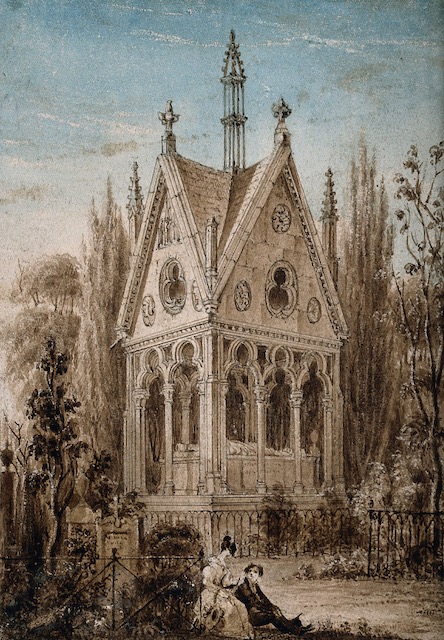
Whitehead had doubted that the grave could be discovered among thousands upon thousands of burials within the walls of Père Lachaise. But, with a certificate of its location obtained at the cemetery office, he and his son started out along the winding avenues, led by a voluble French-speaking guide who pointed out “monuments of great interest, covering the remains of many of the renowned of the earth … the famous soldiers of France, her statesmen, philosophers, scientific men, politicians, musicians and artists….” The cemetery’s most popular attraction captured Whitehead’s notice as well: the recumbent stone effigies of Abélard and Héloïse, the ill-starred lovers of twelfth-century France whose remains were deposited here in 1817. They lay beneath a neo-Gothic canopy made up of fragments of medieval architecture.
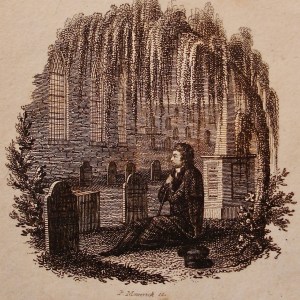
The route on which Whitehead was led, no doubt circuitous, proved interesting, and after an hour or so he and his son were brought to the appropriate section of burials. It required some searching, but they at last reached their objective. Surrounded by a substantial iron railing, there stood a moss-grown headstone with the inscription, “Dunscomb Bradford, Vice Consul U. S. Obit 5 Dec. 1837.”
Whitehead was satisfied to find, from some plantings and the remains of a wreath, that he was not the first to pay his respects, that the lamented Bradford “had not failed at some time to share in the demonstrations common to the place and people.” A reward he would cherish far more, if tinged with regret at the loss in a distant country of so young a friend, was the opportunity to reflect on the privilege, as one of “but few associates” Dunscomb gathered to him in life, of having learned by “his example and precepts.” For, while only two years his senior, Whitehead’s friend had been also his teacher: the spark that impelled him to inquire deeply into Perth Amboy’s early history, and the history of New Jersey “at large,” had come from Dunscomb.20
In an early version of the preface to his East Jersey, Whitehead credited, without naming him, that friend of early life from whom “a taste for such investigations was imbibed,” for, with Dunscomb’s “removal to a foreign land and thence to the grave,” the desire he had kindled in Whitehead “led gradually, and imperceptibly almost,” to a book it had never occurred to him to write. The finished work was “truly the growth of circumstances, the unequal plan bearing no proportion to the result.”21
What are here called “circumstances,” the places and conditions in which it’s our fortune to find ourselves, and the people with whom, if but for a moment, we share them, rarely get their due in accounts of human endeavor. “Circumstances” bring about unlooked-for results, sometimes thwarting our designs. Of his friendship with Dunscomb, Whitehead wrote, “Circumstances caused our pathways to lead us in different directions and the associations of youth were never renewed.”22 But circumstances also made possible a renewal of sorts, at a gravesite in a foreign land: unplanned, unforeseen, but no less poignant.
Historians and biographers, indeed all who have practiced any art or skill for some time, tend to view their own trajectories in retrospect as reasoned and methodical. In fact, there’s a good amount of accident about them and, one hopes, some sentiment too. To treat as noble any pursuit of body or mind seems only proper, provided it’s at least in some measure an affair of the heart.
Copyright © 2025-2026 Gregory J. Guderian
Last revised 2026.01.08
[1] William A. Whitehead, East Jersey under the Proprietary governments: a narrative of events connected with the settlement and progress of the province, until the surrender of the government to the Crown in 1702 [1703] (Collections of the New Jersey Historical Society, 1.) ([New York] 18461) vi, (Newark 18752) v-vi.
[2] For a survey of Bradford’s New Jersey work, see Alexander J. Wall, Jr., “William Bradford, colonial printer. A tercentenary review,” Proceedings of the American Antiquarian Society 73:2 (October 1963) (361-384) 372-380.
[3] W. A. W., “Dunscombe Bradford–Pere La Chaise,” Middlesex County Democrat (Perth Amboy, N.J.) 22 November 1879 2:3, letter of Whitehead’s dated “Paris Nov. 1st, 1879,” Scrapbook Collection, Manuscript Group 1494, SB 14, New Jersey Historical Society, 2:79 (hereafter “W. A. W., ‘Dunscombe Bradford’”). Whitehead’s recollection, some forty years later, of his friend’s Perth Amboy sojourn as having confirmed his own “good intentions and led to persevering efforts at improvement” is preserved in a transcription of his memoir, entitled “Childhood and youth of W. A. Whitehead 1810-1830” (hereafter “Childhood and youth”), of which copies are held by the Florida Keys History Center, Monroe County Public Library, Key West, Florida, and the P. K. Yonge Library of Florida, George A. Smathers Libraries, University of Florida. Page 18 contains the reference.
[4] “Childhood and youth” 23. On Andrews, see my previous post 033–Fathers of invention.
[5] “Childhood and youth” 23-24. Whether guilty of “imprudence of conduct and a want of tenderness towards the reputation of certain members of the church” (as the governing Presbytery determined), or crushed by “four years of the most active intrigue” (as his defenders believed), Rev. Josiah Bishop Andrews departed New Jersey in December 1828, retiring to a farm left him by his late father. See New-York (N.Y.) observer 5 June 1824 2:5; Sentinel of freedom, and New-Jersey advertiser (Newark, N.J.) 8 June 1824 3:1; James Chapman, Perth Amboy 9 December 1828, to Thomas Naylor Stanford, Thomas Naylor Stanford Papers, MC 608, Special Collections and University Archives, Alexander Library, Rutgers University, New Brunswick, N.J.; William A. Whitehead, Contributions to the early history of Perth Amboy and adjoining country, with sketches of men and events in New Jersey during the provincial era (New York 1856) 245; Alfred Andrews, Genealogical history of John and Mary Andrews, who settled in Farmington, Conn., 1640: embracing their descendants to 1872; with an introduction of miscellaneous names of Andrews, with their progenitors as far as known; to which is added a list of some of the authors, clergymen, physicians, and soldiers of the name (Chicago 1872) 263-264; Heman R. Timlow, Ecclesiastical and other sketches of Southington, Conn. (Hartford 1875) 493-494 and [Appendix] ix.
[6] Dunscomb Bradford, 5 July 1831, to David Dickson Bradford, a letter seen by this writer in a private collection in 2017. A British patent, at least, was granted in Dunscomb’s name; see George Hatchell, comp. Abstract of the patent and miscellaneous Rolls of Chancery, inrolled during the reign of William the Fourth. 1830–1837 (Dublin 1838) 25.
[7] Both Cooper and Bradford resided elsewhere during their terms of office, leaving consular duties in the charge of a local merchant. See Samuel Allinson, London 27 January 1835, in Despatches from United States Consuls in Lyons, 1829-1906, Record Group 59, General Records of the Department of State, National Archives and Records Administration, Microcopy T169, Roll 1, Volume 1, July 17, 1829–December 1, 1854 (Washington 1959; hereafter “Despatches … Lyons, Vol. 1”). Cf. James Franklin Beard, ed. The letters and journals of James Fenimore Cooper (6 vols. Cambridge, Mass. 1960-1968) 1:182.
[8] Cornelius Bradford, Alexandria, Egypt, 20 February 1830, to Martin Van Buren, in Despatches … Lyons, Vol. 1.
[9] For Cornelius Bradford’s last years (and some unsavory reports about him), see Andrew Oliver, American travelers on the Nile. Early U.S. visitors to Egypt, 1774–1839 (Cairo and New York 2014) 125-131.
[10] Dunscomb Bradford, Paris 26 April 1835, to John Forsyth; Daniel Brent, Washington 7 January 1834, to Louis McLane; Daniel Brent, New York 30 April 1834, to Louis McLane; Daniel Brent, Paris 14 June and 5 July 1834, to Louis McLane. Despatches from United States Consuls in Paris, 1790-1906, Record Group 59, General Records of the Department of State, National Archives and Records Administration, Microcopy T1, Roll 7, Volume 7, July 24, 1832–December 30, 1835 (Washington 1959; hereafter “Despatches … Paris, Vol. 7”).
[11] When Cornelius was being considered for the post at Lyon, the Marquis wrote to Secretary of State Henry Clay: “Mr Bradford Whose intimacy With Us Has Given me full Scope to know Him well is one of the Best, most Sensible, and Noble minded Young Gentlemen I ever met in my life. He is Universally Beloved.” Lafayette, La Grange 28 October 1828, to Henry Clay, in Robert Seager II et al., edd., The papers of Henry Clay 7 (Lexington, Ky. 1982) 521.
[12] Dunscomb Bradford, Paris 31 May 1834, to Louis McLane, Secretary of State, Despatches … Paris, Vol. 7. See Francis J. Lippitt, Washington 8 October 1881, to General W. T. Sherman, in “The funeral of Lafayette,” The times-picayune (New Orleans, La.) 16 October 1881 9:2, and “Lafayette’s funeral,” The national tribune (Washington, D.C.) 22 October 1881 3:5. Bradford was secretary of a committee of Americans residing in France formed to convey condolences to the family: “Funeral of Lafayette,” The evening post (New York, N.Y.) 3 July 1834 2:4-5; New-York (N.Y.) American 5 July 1834 2:4-5. The U.S. Legation’s accounts show 483 French francs were expended on “Mourning for Genl: Lafayette (including crepe &c used by the Americans at a meeting)”: Disbursement account for U.S. Legation, 1833-1834, Edward Livingston Papers, C0280, Manuscripts Division, Department of Special Collections, Princeton University Library (hereafter “Edward Livingston Papers, Princeton”), Box 71/11. Cf. “History of the Paris consulate general,” American consular bulletin 2:11 (January 1921) (9-13) 11.
[13] A defense of President Jackson’s position on French spoliation claims, Edward Livingston’s final official communication as U.S. minister to France survives in draft form in Dunscomb Bradford’s hand, with multiple alterations and deletions; see Letters Sent to the French Ministers of Foreign Affairs, 1833-1835, Edward Livingston Papers, Princeton, Box 69/35. From a letter evidently meant for the American press and inscribed “Arma virumque cano,” seen by this writer in a private collection in 2017, it appears that Dunscomb had his own views of the French crisis.
[14] “Relations with France,” The enquirer (Key West, Fla.) 14 March 1835 3:1; The enquirer 28 March 1835 3:1-2; The enquirer 11 April 1835 3:1.
[15] The enquirer 18 April 1835 3:1.
[16] Cf. The evening post 30 November 1838 3:7 and “Private library,” ibid. 2:5; New-York (N.Y.) commercial advertiser 30 November 1838 3:7, “Private library,” ibid. 2:7 and “Choice books,” ibid. 2:2. For Whitehead’s first few months as a resident of New York City, see my previous post 044–Barrow Street.
[17] Cortlandt Whitehead, letters of 29 August, 8 and 12 September 1879, Letters from Europe, in Papers of Bishop Cortlandt Whitehead, Archives of the Diocese of Pittsburgh (hereafter “Letters from Europe”).
[18] W. A. W., “Dunscombe Bradford.”
[19] W. A. W., “Dunscombe Bradford.” See also Cortland Whitehead, Paris 31 October–1 November 1879, Letters from Europe.
[20] “Childhood and youth” 19. Dunscomb’s interest in New Jersey’s past must have drawn inspiration from his own ancestry. He was the principal author (under the name Daniel D. Bradford) of a “genealogical table being the lives of William Bradford and his descendants,” dated 1825, seen by this writer in a private collection in 2017.
[21] Bound manuscript of East Jersey under the proprietary governments (see note 1 above) 3-4, Manuscript Group 177, William A. Whitehead Papers, New Jersey Historical Society.
[22] W. A. W., “Dunscombe Bradford.”
 An attractive presence