075–Old Mortality

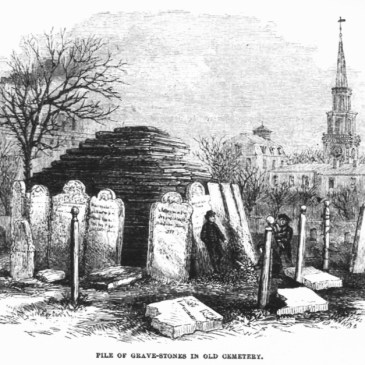
NO human lives were lost when fire destroyed Edward Stewart’s United States Hotel. But upon the plight of hundreds already dead, the 1844 blaze cast a lurid glow.1 Stewart’s hotel stood upon ground that the first settlers of Newark had early reserved for common use. Thirty years after their arrival, the dimensions and limits of … More 075–Old Mortality

068–Tift’s Tower

GAZING one last time at a pair of large, unfurled sheets of paper, William A. Whitehead traced with his eye the busy waterfront, the streets and buildings depicted on them. Then, possibly with a faint smile, he again rolled them up carefully to be delivered to their final destination. License to imagine such an interlude … More 068–Tift’s Tower

058–Climate of Newark

RECENTLY, there were reports that the Oxford English Dictionary had identified the earliest use of the term “climate change.” In the context in which they appeared–an American scientific magazine of 1854–and even in their inflection, the words differed somewhat from how we read and understand them today. But it’s evident from the brief article where they were … More 058–Climate of Newark

057–The Daily

BETWEEN the day on which William A. Whitehead, at age 13, left Newark with his family for Perth Amboy and the day that he returned, at age 33, to live there once more with a new family, the place, like Whitehead, had come of age. The Newark he returned to was a far cry from … More 057–The Daily

055–Library Hall

CONVERSATIONS on the New York train touched on topics from the mundane to the sublime, but among a few regular Newark commuters the talk revolved, more often than not, around books. One morning in 1846, as we’re told, the discussion veered from the contents of books to their numbers and distribution: shelves in some homes groaned … More 055–Library Hall

052–Field work

CONVENING in January 1846 at the place of its birth to celebrate the New Jersey Historical Society’s first year, members could look back with satisfaction, and look expectantly ahead. They reviewed the Society’s achievements over the past eleven months, chose officers for the year to come–a formality, as the incumbents were re-elected without exception and … More 052–Field work

050–Meetings of minds

LONG after the event, William A. Whitehead recalled how, through the 1845 founding of a historical society for New Jersey, he penetrated a circle of “several prominent gentlemen … whom I had never met before.”1 By many standards, Whitehead would have been regarded as an interloper. The men who gathered in Trenton that February worked … More 050–Meetings of minds

049–Try, try again

MORE ancient and enduring than New Jersey’s status as a Revolutionary battleground has been its contest for self-definition. The state is often coarsely cast as suffering a kind of bipolar disorder, forever torn between the megacities it faces across its two frontier rivers. The nature of that struggle is of course far more complex, variously … More 049–Try, try again

047–Moving Day

“DO you want,” pronounced an eminent journalist, “an appropriate emblem of this country, and this age? Then stand on the side-walks of New-York, and watch the universal transit on the first of May.” We could suppose the scene to which Lydia Maria Child referred was some rite of rejuvenation, an urban awakening to the warmth … More 047–Moving Day